
Most companies treat retention as a back-office function. Customer service handles it. Onboarding is an afterthought. Churn is accepted as “normal.”
This is a dangerous mistake.
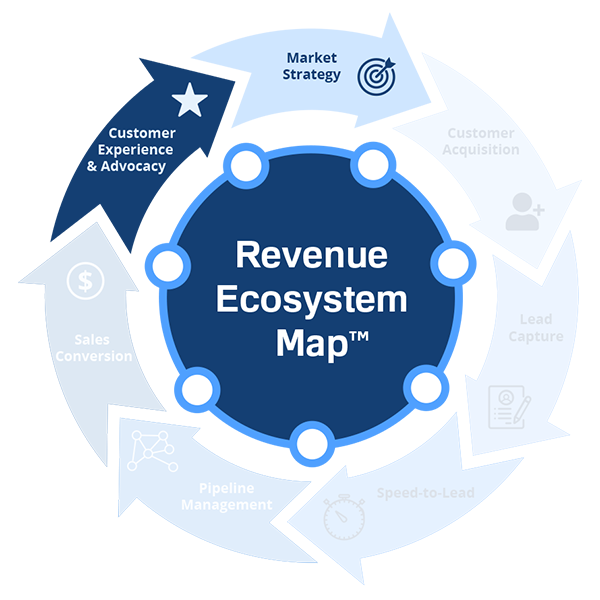
Retention is not the end of the revenue system. It feeds the beginning.
Strong retention generates referrals. It produces reviews and testimonials. It lowers your Customer Acquisition Cost (CAC). It increases customer lifetime value (LTV). It turns customers into advocates who bring you new leads at near-zero cost.
Weak retention does the opposite: constant replacement, higher ad spend, lower margins, and stalled growth.
The Hidden Math of Churn
Let’s make the cost of churn concrete.
Assume:
- 500 active customers
- Average monthly revenue per customer: $1,000
- Monthly churn rate: 5%
- CAC: $2,000
Each month, you lose: 500 × 5% = 25 customers
Lost monthly revenue: 25 × $1,000 = $25,000
Replacement cost: 25 × $2,000 = $50,000 in acquisition spend just to stay flat
Now reduce churn to 3%:
- Lost customers: 15 (instead of 25)
- Lost revenue: $15,000 (saved $10,000/month)
- Replacement CAC savings: $20,000/month
Total monthly gain from 2% churn reduction: $30,000
That’s not incremental. That’s transformative.
Reducing churn by 2% can be worth more than increasing lead volume by 20% – because you keep what you already have.
Why Retention Feeds Acquisition (The Loop)
Retention does not exist in isolation. It feeds every upstream stage.
Referrals
A happy customer refers a colleague. That referral becomes a new lead with:
- Higher trust (warm introduction)
- Lower cost to acquire (no ad spend)
- Higher close rate (trust prebuilt)
Reviews & Testimonials
A retained customer leaves a 5-star review. That review influences dozens of future prospects. It strengthens your brand. It improves conversion on your website.
Lower CAC
Every customer who stays reduces the number of new customers you need to replace them. You can spend less on ads for the same growth.
Upsells & Expansion
A retained customer buys additional services. That revenue has zero acquisition cost and high margin.
Why Most Retention Systems Fail
1. Onboarding is weak
Customers don’t see value early. They churn before their first renewal.
2. No proactive communication
Silence equals indifference. Customers who don’t hear from you assume you don’t care.
3. No churn warning system
You don’t know who is at risk until they leave. No usage tracking, no satisfaction surveys, no early intervention.
4. No referral ask
Happy customers are never asked to refer. Advocacy is left to chance.
5. No offboarding process
When customers leave, you don’t ask why. Patterns go unnoticed. Fixable problems repeat.
How to Build a Retention Engine
Step 1 – Fix onboarding
The first 30 days predict long-term retention.
- Welcome email or call within 24 hours.
- Clear timeline of what happens when.
- Quick win delivered within first week.
- Identify a customer success owner.
Step 2 – Measure retention metrics
- Monthly churn rate (by cohort)
- Net Revenue Retention (NRR)
- Customer satisfaction (NPS or survey)
- Usage frequency
If you can’t measure it, you can’t improve it.
Step 3 – Proactive communication
- Monthly check-in emails or calls.
- Quarterly business reviews for high-value accounts.
- Milestone celebrations (anniversary, usage milestone).
Step 4 – Ask for referrals and reviews
At the moment of highest satisfaction (e.g., after a big win, at renewal), ask:
- “Would you be willing to refer us to a colleague?”
- “Could you leave a review on Google?”
Make it easy: provide a template or a link.
Step 5 – Monitor churn risk
- Track login frequency, support ticket volume, payment delays.
- Flag accounts with decreasing usage.
- Assign a retention agent to reach out before they churn.
Step 6 – Learn from lost customers
When a customer leaves, ask:
- Why did you decide to leave?
- What could we have done differently?
- Would you consider returning if we fixed X?
Use the answers to improve.
The most profitable customer is the one you already have. Retention is not a cost center – it’s a growth multiplier.
How the Self-Assessment Helps
The Revenue System Self-Assessment™ includes questions about:
- Onboarding process
- Churn tracking
- Referral and review systems
- Customer communication cadence
If you score low in Customer Experience & Advocacy, the assessment will flag it as a priority leak.
The Estimator Connection
Our Revenue Leakage Estimator™ includes a retention module. It calculates the financial impact of reducing churn.
Example inputs:
- Active customers
- Average monthly revenue per customer
- Current churn %
- Improved churn %
Output: monthly and annual retention opportunity.
Retention is not a support function. It’s a growth engine.
Reduce churn. Improve onboarding. Ask for referrals. Measure. Iterate.
You’ll spend less on acquisitions and grow faster – because you’ll keep what you already have.