
When leaders think about lost revenue, they usually imagine big failures:
- A $100k deal lost to a competitor.
- A marketing campaign that flopped.
- A key customer who left without warning.
Those hurt. But they aren’t the main culprit.
The real drain is quieter. It’s a 5% miss here, a 10% delay there, a 6% conversion drop over there. By themselves, each feels small – not worth a fire drill. But when you add them up across all 7 stages of your revenue system, the cumulative loss can be 30-40% of your potential revenue.
That’s the quiet drain that makes growth feel so hard. You’re working hard, spending money, hiring people – but you’re leaking everywhere.
The Anatomy of a Small Leak
Let’s define what a “small leak” looks like in real business operations.
Leak Type | Example | Annual Impact (for $5M company) |
Missed leads | 5% of inbound calls go to voicemail, never returned | $50k – $100k |
Slow response | 4-hour average response time vs 5 minutes | $100k – $200k |
No-show appointments | 8% of scheduled calls never happen | $40k – $80k |
Weak close rate | 6% below industry benchmark | $150k – $300k |
Excess churn | 7% monthly churn instead of 4% | $150k – $250k |
Individually: each seems manageable.
Together: they can exceed $500k in lost annual revenue.
A 5% miss isn’t a crisis. But a 5% miss + a 10% delay + a 6% conversion gap + 3% extra churn = a completely different business outcome.
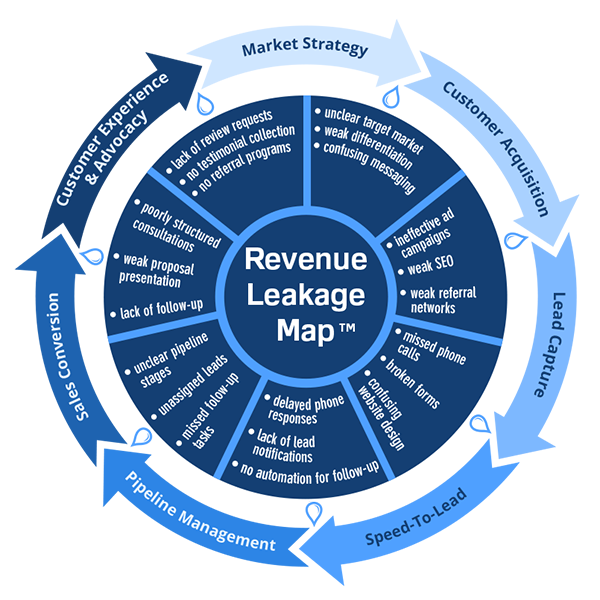
Where Leaks Hide (Stage by Stage)
Using our Revenue Ecosystem Map™, here’s where to look for small leaks:
1. Market Strategy
- Vague ICP → wrong prospects → wasted sales time.
- Weak differentiation → price pressure → lower margins.
2. Customer Acquisition
- Over-reliance on one channel → volatility.
- No attribution → you don’t know what works.
3. Lead Capture
- Broken forms → abandoned inquiries.
- Missed calls → lost opportunities.
4. Speed-to-Lead
- Response time measured in hours, not minutes.
- No follow-up cadence → leads go cold.
5. Pipeline Management
- Stale deals in CRM → inflated forecast.
- No stage-exit criteria → deals stuck.
6. Sales Conversion
- Inconsistent discovery → wrong solutions proposed.
- No proposal follow-up → deals die silently.
7. Customer Experience & Advocacy
- Weak onboarding → early churn.
- No referral ask → leaving growth on the table.
Why Small Leaks Compound
Compounding is not just for interest rates. It works for revenue leakage too.
Example:
- Start with 100 leads.
- Leak #1 (capture): 5% never become leads → 95 remain.
- Leak #2 (response): 10% never contacted in time → 85 remain.
- Leak #3 (qualification): 8% unqualified → 78 remain.
- Leak #4 (conversion): 6% close rate gap → final customers = far fewer than possible.
Each leak alone costs a little. Together, they transform your top line.
Formula:
Potential Revenue – (Leak1 × Leak2 × Leak3 …) = Actual Revenue
Most businesses never run this math. That’s why they underestimate leakage by 2-3x.
How to Find Your Leaks (Without a Consultant)
You don’t need a paid engagement to start. Our Revenue System Self-Assessment™ is a free, 30-question tool that scores each of the 7 stages on a 1-10 scale.
At the end, you’ll see:
- Your strongest stage (where to protect).
- Your weakest stage (where to focus).
- A visual of your leak profile.
It takes 7 minutes. It’s free.
What to Do After You Find Your Leaks
Once you know your weakest stage, you can prioritize.
- Low score in Speed-to-Lead? → Automate routing, set SLAs, install missed-call recovery.
- Low score in Pipeline Management? → Redefine stages, implement weekly reviews, clean stale deals.
- Low score in Sales Conversion? → Build qualification playbook, proposal templates, follow-up cadence.
If you want a root-cause analysis and a prioritized roadmap, book a Revenue Pipeline Diagnostic™. But start with the free Self-Assessment.
Revenue leakage is not one explosion. It’s 5% here, 10% there, 6% somewhere else.
Stop ignoring small leaks. Measure them. Prioritize them. Fix them.
Take the free Self-Assessment today. See where you stand.