
Misdiagnosis is expensive.
Not in theory. In real dollars. Companies spend fortunes fixing the wrong problem – while the real leak quietly drains revenue.
Here are real examples from our diagnostic work. The numbers are anonymized but the patterns are repeated across industries.
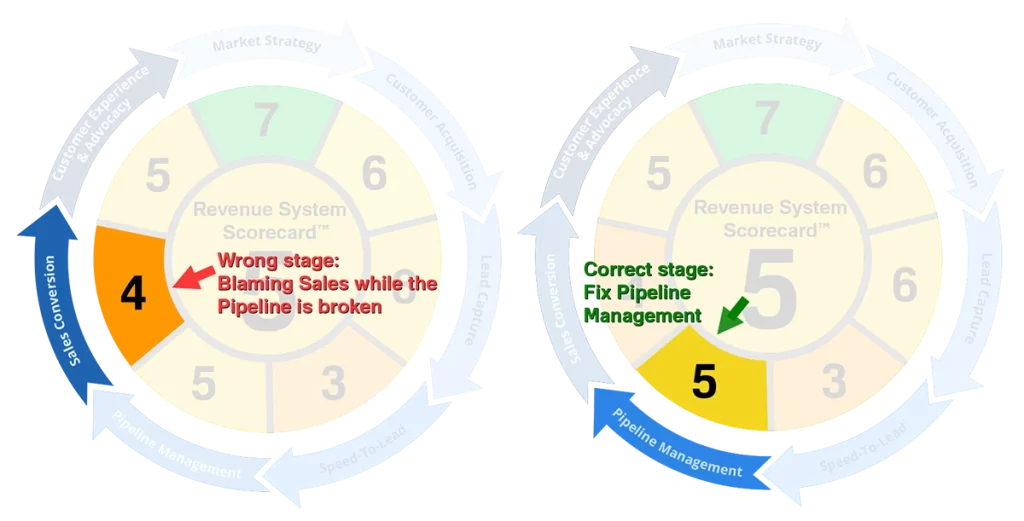
Cost: $150k (manager salary + training). Correct fix subtext: Cost: $8k.
Example 1: The “Lead Quality” Trap
Client: Home services company, $6M revenue.
Symptom: Low conversion from leads to customers. Marketing blamed sales. Sales blamed leads.
Their initial fix: Spent $50,000 on new ad channels to get “better leads.” Results didn’t improve.
Actual problem (from Diagnostic): Response time averaged 4 hours. Leads were contacting competitors before they ever heard back. No lead alerts. Manual routing.
Correct fix: Automated lead routing, SMS alerts, SLA (5 minutes). Cost: $15,000.
Result: Response time dropped to 6 minutes. Contact rate tripled. Close rate increased 12%. Annual revenue increased over $400,000.
Wasted spend: $50,000. Correct fix ROI: 26x.
They spent $50k on the wrong fix. The diagnostic cost $7.5k. The correct fix cost a total of $15k. The return was over $400k annually. Misdiagnosis is expensive.
Example 2: The “Lazy Reps” Mistake
Client: B2B professional services, $10M revenue.
Symptom: Stalled pipeline. Deals sitting for weeks with no movement.
Their initial fix: Hired a sales manager ($120k/yr) to “motivate the team.” Also spent $30k on sales training.
Result: No improvement. Reps were still struggling.
Actual problem (from Diagnostic): Pipeline stages were undefined. No exit criteria. No automated follow‑up tasks. Reps didn’t know what “qualified” meant.
Correct fix: Redefined stage criteria, added required next steps, installed task automation. Cost: $8k (internal time + CRM configuration).
Result: Pipeline velocity increased 40% in 60 days. Same reps. No new manager needed.
Wasted spend: $150k (manager salary + training). Correct fix cost: $8k.
Example 3: The “Onboarding” Red Herring
Client: SaaS company, $5M ARR.
Symptom: High churn (8% monthly).
Their initial fix: Redesigned onboarding experience. Beautiful welcome emails, tutorials, etc. Cost: $40k.
Result: Churn unchanged. Customers still left at 90 days.
Actual problem (from Diagnostic): Customers didn’t see value until 60 days, but the product’s first “aha moment” required configuration that most didn’t complete. No proactive check‑ins. No usage tracking.
Correct fix: Added in‑product guidance, automated usage tracking, proactive customer success calls at day 30 and 60. Cost: $25k.
Result: Churn dropped from 8% to 4.5% in 90 days. Net Revenue Retention increased 15%.
Wasted spend: $40k. Correct fix cost: $25k. Annual retained revenue: Over $500k.
The Math of Misdiagnosis
Scenario | Wrong Fix Cost | Diagnostic Cost | Correct Total Fix Cost | Wasted | ROI of Right Fix |
Lead quality trap | $50k | $7.5k | $15k | $35k | 26x |
Lazy reps mistake | $150k | $7.5k | $8k | $142k | 50x+ |
Onboarding red herring | $40k | $7.5k | $25k | $15k | 20x |
In each case, the diagnostic fee was a fraction of the wasted spend. And the right fix paid for itself many times over.
The diagnostic fee is rarely the expensive part. Wrong moves are.
Why Leaders Keep Making These Mistakes
- They fix what’s visible – Sales training, ad spend, and onboarding redesigns are visible. Root cause analysis is invisible – until you do it.
- They listen to the loudest voice – The loudest voice often points away from their own department.
- They assume past fixes worked – Without measurement, you don’t know if you fixed the leak or just moved it.
- They don’t have a framework – Without a structured way to evaluate all 7 stages, you react to symptoms, not causes.
How to Avoid Misdiagnosis
Step 1 – Resist the urge to “fix” immediately – When a problem appears, pause. Don’t throw money at the obvious suspect.
Step 2 – Use the Self‑Assessment – Score each of the 7 stages. Low scores point you in a direction.
Step 3 – Quantify with the Estimator – Estimate the financial impact of improving each low‑scoring stage. Prioritize the biggest opportunities.
Step 4 – Get a Diagnostic for root cause – If the opportunity is large (>$100k) and you don’t know the root cause, book a Revenue Pipeline Diagnostic™.
Misdiagnosis is expensive. The companies in these examples wasted hundreds of thousands of dollars fixing the wrong thing.
Don’t let that be you.
Measure. Diagnose. Then fix.