
When a lead comes in, the clock starts.
Most companies treat response time as an operational metric – something to monitor, maybe a nice to have. But that framing is dangerously incomplete.
Response time isn’t about “being fast.” It’s about controlling the buying process.
The first business to respond shapes the buyer’s decision criteria. What matters, what’s compared, how urgency is perceived – all influenced by who speaks first.
The slower responder enters a different conversation entirely. By the time they reply, the lead has already formed opinions, possibly engaged with a competitor, and set expectations. Now the slower business is reacting, not leading.
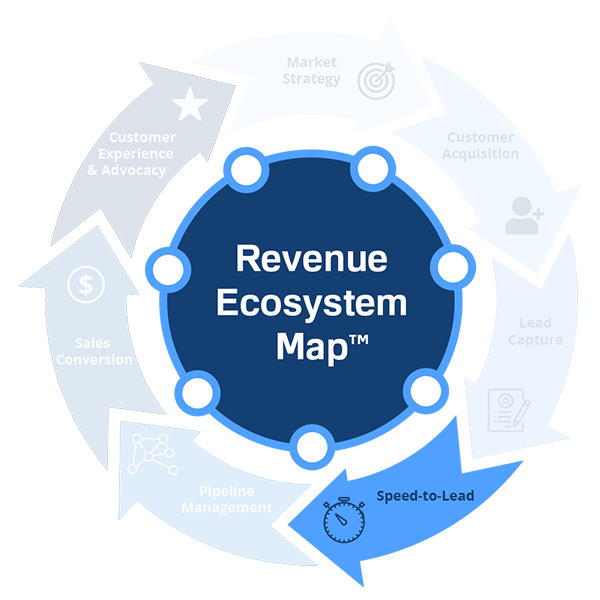
The Data That Should Terrify You
Research consistently shows:
- Responding within 5 minutes dramatically increases contact and conversion rates.
- Every hour of delay reduces the odds of contact by 7%–15%.
- After 24 hours, a lead is 90% less likely to convert than one contacted immediately.
Yet the average company takes 4-6 hours to respond to an inbound lead. Some take 24 hours. Some never respond at all.
A lead responded to in 5 minutes has a 21% contact rate. At 30 minutes, it drops to 15%. At 2 hours, under 10%.
Why Speed Is a Revenue Variable, Not a KPI
Most teams put response time on an ops dashboard. That’s where it lives – quietly, unexamined.
But response time directly drives:
- Contact rates – The faster you respond, the more likely you reach the prospect before they move on.
- Show rates – Early engagement sets expectations and reduces no-shows.
- Competitive positioning – The first responder shapes the buyer’s criteria.
- Conversion probability – Every hour of delay reduces the odds of closing.
Improving response time from 4 hours to 5 minutes is not an operational win – it’s a revenue win.
Example math:
- 200 leads/month
- 20% contact rate at 4 hours → 40 contacts
- 40% contact rate at 5 minutes → 80 contacts
- Assuming 25% close rate on contacted leads, that’s 10 more customers per month.
- At $5,000 average value → $50,000/month increase = $600,000/year.
That’s not efficiency. That’s growth.
Where Slow Response Happens (And Why)
Slow response isn’t usually laziness. It’s a system failure.
Common causes:
- No lead alerts – Reps don’t know a lead arrived.
- Unclear ownership – Everyone assumes someone else will call.
- After-hours gap – Leads arrive at 8pm, no response until 9am.
- Weak follow-up cadence – One call attempt, then nothing.
- No SLAs – No one is measured on response time.
How to Fix It
The good news: Speed-to-Lead is one of the fastest and cheapest leaks to fix.
Step 1 – Measure reality
Track average response time, median response time, and percentage of leads contacted within 5 minutes. Most teams are shocked at their actual numbers.
Step 2 – Install instant alerts
Every new lead should trigger an SMS, Slack, or CRM notification to the assigned owner.
Step 3 – Define ownership
Every lead has one person responsible for first contact (and a backup).
Step 4 – Set SLAs
All leads contacted within 5 minutes during business hours. Missed calls returned within 10 minutes.
Step 5 – Automate after-hours
Auto-reply emails or texts with a call-back promise and scheduling link.
Step 6 – Follow-up cadence
If no response after first attempt, schedule 2-3 more attempts over 24 hours.
Step 7 – Inspect
Managers review response time reports daily. Slow leak flags.
We’ve seen companies cut response time from 2 hours to 5 minutes in one week, with no new hires – just routing, alerts, and SLAs.
How to Know What Your Delay Is Costing You
You can estimate the financial impact using our Revenue Leakage Estimator™ (free, 2 minutes).
Or, use the math above:
(Current contact rate vs target) × (leads/month) × (close rate) × (average value)
But the Estimator does it for you.
The Self-Assessment Connection
The Revenue System Self-Assessment™ includes specific questions about your response time, routing, and after-hours process.
If you score low in Speed-to-Lead, the assessment will flag it as a critical leak. Then you can:
- Fix it yourself using the steps above.
- Book a Revenue Pipeline Diagnostic™ for a full root cause analysis.
- Use the Estimator to see what it’s costing you.
But awareness comes first. Take the Self-Assessment.
Slow response is not a minor operational issue. It’s a revenue leak that cedes control of the buying process to faster competitors.
Measure it. Fix it. Then watch your contact rates, conversions, and revenue grow – without spending a dollar more on ads.