
Every year, businesses pour billions into growth initiatives:
- More ads.
- More salespeople.
- New software.
- Training programs.
- New campaigns.
Some of these investments pay off. Many don’t.
Why? Not because the ideas were bad – but because they were aimed at the wrong stage.
Without a system-level diagnosis, you’re gambling. You might get lucky. But more often, you’ll waste time, money, and momentum.
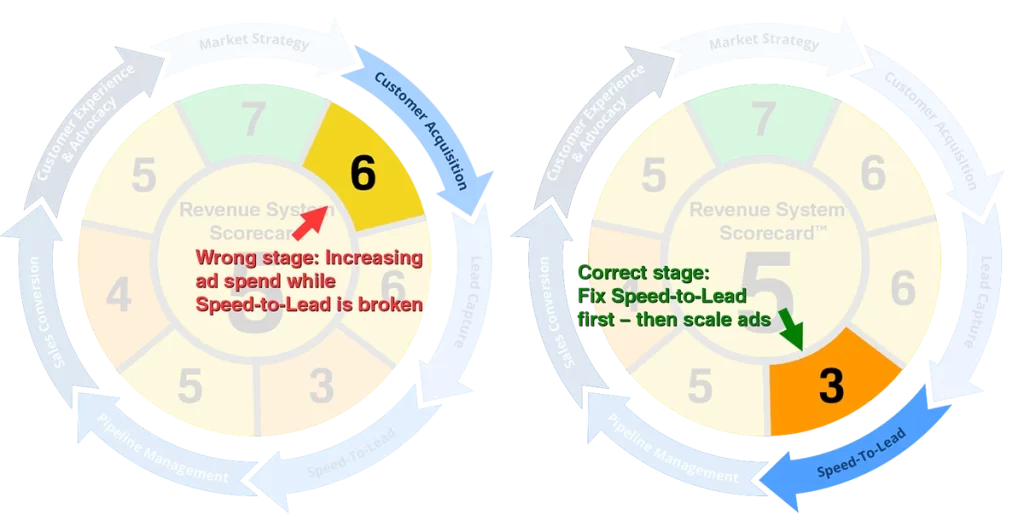
Mistake – Optimizing the wrong constraint. Correct – Fixing the real bottleneck.
The Common Wasted Investments
1. More leads (without fixing response)
You increase ad spend – but response time is slow. More leads enter a broken system. Contact rate drops. Conversion falls.
Result: You spent money to amplify waste.
Better question: Before scaling traffic, is Speed-to-Lead optimized?
2. Sales training (without pipeline discipline)
You invest in a sales trainer – but pipeline stages are undefined. Reps learn new skills, but they still don’t know which leads are qualified.
Result: Training dollars wasted. Reps are still working blind.
Better question: Is the pipeline structured? Do reps have clear stage definitions?
3. New CRM (without process design)
You buy expensive CRM software – but you haven’t defined your sales process. You digitize chaos.
Result: Expensive software, same problems.
Better question: Have you mapped your process before buying tools?
4. More salespeople (without qualification process)
You double the sales team – but leads aren’t qualified before handoff. Reps spend time on unready prospects.
Result: More reps, not more revenue. Burnout follows.
Better question: Is there a qualification handoff between marketing and sales?
5. Better onboarding (without fixing churn root cause)
You improve onboarding – but customers leave after 90 days because of product gaps. Onboarding doesn’t fix late-stage churn.
Result: You optimized the wrong stage.
Better question: Do you know why customers actually leave?
The most expensive money you spend is the money you spend on the wrong stage. Diagnosis is cheap. Guessing is expensive.
The Right Sequence (Measure → Diagnose → Prioritize → Improve)
Step 1 – Measure
Use the Revenue System Self-Assessment™ to score each stage 1-10.
Step 2 – Diagnose
For low-scoring stages, dig deeper. Is it a technology issue? Process? People? A full Diagnostic can answer.
Step 3 – Prioritize
Not all low scores are equal. Use the Revenue Leakage Estimator™ to see which stage, if improved, would create the biggest financial impact.
Step 4 – Improve
Now invest. But invest in the right stage.
Real Example: Wrong Fix vs Right Fix
Company: $4M professional services firm.
Symptom: Revenue plateaued. Marketing blamed sales. Sales blamed leads.
Wrong fix (what they tried first): Increased ad spend by $20k/month. No change.
Second wrong fix: Hired a sales trainer ($15k). No change.
Third fix (after diagnosis): We ran a Diagnostic. Found that response time averaged 6 hours. Leads were going to competitors.
Right fix: Automated lead routing, SMS alerts, SLA. Cost $3k.
Result: Response time dropped to 6 minutes. Contact rate tripled. Revenue up 28% in 90 days.
Total wasted before diagnosis: $60k. Cost of correct fix: $3k. Return: Over $1M annual.
How to Avoid Wasting Your Own Investment
Before spending on any growth initiative, ask three questions:
- Have we measured the current state of the stage we’re trying to improve? (If not, pause.)
- Is this stage the real bottleneck? (Use the Estimator to compare impact across stages.)
- What downstream effects will this improvement have? (Will other stages be able to handle the change?)
If you can’t answer these, you’re not ready to invest.
The Role of the Self-Assessment and Estimator
The Self-Assessment gives you baseline scores.
The Estimator gives you financial impact of improving each stage.
Together, they help you prioritize before you spend.
When to Book a Diagnostic
If you’ve made investments that didn’t pay off, or if you’re unsure which stage is the real bottleneck, book a Revenue Pipeline Diagnostic™.
We’ll analyze your system, identify the highest-leverage fix, and deliver a roadmap – so you never waste money on the wrong stage again.
Most improvement efforts are wasted not because the ideas are bad, but because they’re aimed at the wrong stage.
Stop gambling. Measure first. Diagnose second. Then invest.
The right fix costs less and returns more.