
You pour money into ads. You optimize your website. You hire a marketing agency. And still, growth stalls.
The common reaction: “We need more leads.” So you spend more. But the results don’t improve. Why?
Because more leads into a broken system doesn’t create growth – it creates waste.
Most businesses don’t have a lead problem. They have a revenue system problem.
The Hidden Cost of Lead-Only Thinking
When lead volume is the only focus, companies pour money into:
- More ads
- More traffic
- More outreach
But if the underlying system is broken – fragmented follow-up, messy pipeline, slow response – those leads never convert efficiently.
Think about it: you generate 100 leads. But:
- 20% of inbound calls go to voicemail and are never returned.
- Response time averages 4 hours – enough time for a competitor to engage first.
- Your CRM pipeline stages are vague, so reps don’t know what “qualified” means.
- Follow-up after a proposal is inconsistent – deals just go cold.
How many of those 100 leads actually become customers? Far fewer than they should.
That’s not a lead problem. It’s a system problem.
More leads into a broken system doesn’t fix the leak – it just makes the leak more expensive.
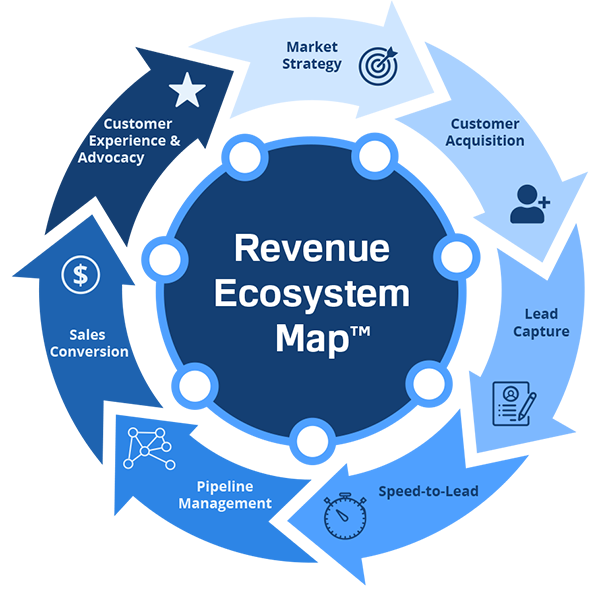
Introducing the 7-Stage Revenue System
Revenue is produced by a system – a series of interconnected stages that each must function for growth to happen efficiently.
We break that system into 7 stages:
- Market Strategy – Who you target, how you position, what you offer.
- Customer Acquisition – How you attract leads (ads, SEO, referrals, outreach).
- Lead Capture – How inquiries become identifiable leads (forms, calls, chat).
- Speed-to-Lead – How quickly and consistently you respond to new opportunities.
- Pipeline Management – How you track, stage, and advance deals.
- Sales Conversion – How you turn qualified opportunities into customers.
- Customer Experience & Advocacy – How you retain clients, generate reviews, and earn referrals.
A breakdown in any stage does not stay isolated. It cascades.
Example: Weak Market Strategy → poor lead quality → longer sales cycles → lower close rates → fewer reviews → harder acquisition.
Isolated tactics – like improving sales scripts while ignoring lead capture – only move the bottleneck elsewhere. You need to see the whole system.
How Leakage Accumulates (Small Leaks, Large Impact)
Revenue leakage rarely looks dramatic. It accumulates across stages in small, often ignored ways:
- 5% of leads are never worked (missed calls, forms not followed up).
- Response time averages 4 hours when it should be 5 minutes.
- 8% of scheduled appointments no-show.
- Close rate is 6% lower than industry benchmark.
- 7% of customers churn every month without a retention attempt.
Individually, each feels manageable. But when you add them up across all 7 stages, the cumulative effect can be 30-40% of potential revenue.
That’s the quiet drain that makes growth feel so hard. You’re working hard, but you’re leaking everywhere.
What You Can Do Today (Free Self-Assessment)
You don’t need to hire a consultant to start diagnosing your revenue system. You can do it yourself – in about 7 minutes.
Our Revenue System Self-Assessment™ is a 30-question tool that scores each of the 7 stages on a 1-10 scale. It asks practical questions about your market strategy, lead capture, response time, pipeline management, sales conversion, and customer advocacy.
At the end, you get:
- A stage-by-stage scorecard showing your strongest and weakest areas.
- A visual of where you’re likely leaking revenue.
- A personalized summary of what to focus on first.
It’s free. See your complete stage‑by‑stage scorecard instantly, then enter your email to save or download the report.
You don’t need more leads. You need a clearer view of your revenue system. Start by measuring each stage. Then fix the biggest leak.
Take the free Self-Assessment today. See where you stand.