
Introduction
After diagnosing revenue systems across dozens of industries, the same six leaks appear again and again. They are not exotic. They are not industry-specific. They are systemic and fixable.
If you’re experiencing stalled growth, inconsistent conversion, or rising costs, you likely have one or more of these.
Here they are – and how to fix them.
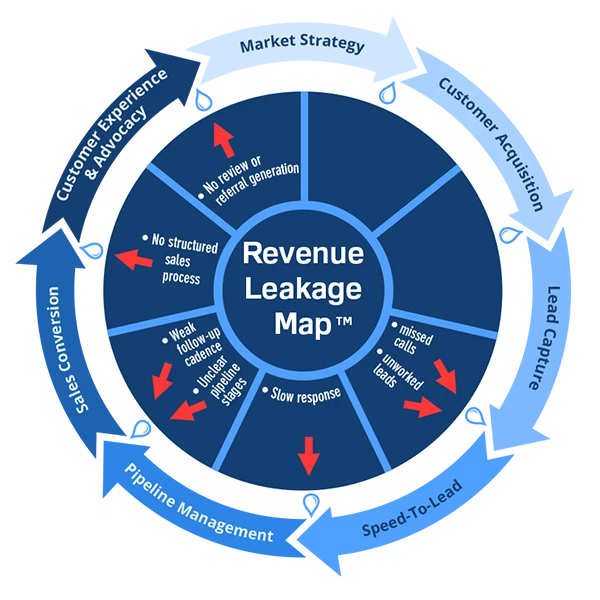
The six most common revenue leaks – highlighted on the Revenue Leakage Map™
Leak #1 – Missed Calls / Unworked Leads
What it looks like: Inbound calls go to voicemail and are never returned. Web form inquiries are ignored. Live chat messages receive no reply. Leads sit in a “new lead” queue for days.
Why it happens: No lead notification system. Unclear ownership. No SLA for response time. Understaffed at peak hours.
How to fix it: Install instant lead alerts (SMS, Slack, CRM notification). Define clear ownership (e.g., round-robin assignment). Set SLA: “All leads contacted within 5 minutes.” Add missed-call recovery (autotext with callback link).
Estimated impact: Often $50k-$200k per year for a midsized business.
A lead that is never worked is not a ‘lost opportunity’ – it’s a guaranteed zero. Fixing this is often the fastest win.
Leak #2 – Slow Response
What it looks like: Average response time measured in hours, not minutes. Leads contacted the next day (or later). After-hours inquiries sit until morning.
Why it happens: No lead alerts. Manual routing. No after-hours coverage. No management inspection.
How to fix it: Measure current response time. Install automated routing and alerts.
Create an SLA: “All leads contacted within 5 minutes.” After-hours auto-reply with scheduling link. Daily response time report for managers.
Estimated impact: Often $100k-$500k per year.
Leak #3 – Weak FollowUp Cadence
What it looks like: One call attempt, then silence. No email followup. No persistence. Proposals sent, never followed up.
Why it happens: No defined cadence. No automation. Reps are overworked. No management accountability.
How to fix it: Define a standard cadence (e.g., Call 1 → Voicemail → Text → Email → Call 2 next day → Email 2). Automate tasks in your CRM. Require next step for every deal. Weekly pipeline inspection.
Estimated impact: Often $50k-$250k per year.
Leak #4 – Unclear Pipeline Stages
What it looks like: Reps don’t know what “qualified” means. Deals jump from “new” to “closed won” with no visible steps. Forecasts are consistently wrong. Stale deals accumulate.
Why it happens: Stage definitions are vague or missing. No exit criteria. No training. CRM is configured poorly.
How to fix it: Write one sentence for each stage that must be true to enter and exit (e.g., for “Qualified”: “Prospect has confirmed budget, authority, need, and timeline within 90 days”). Train reps on the definitions. Add required fields for stage movement.
Estimated impact: Often $100k-$500k per year (from forecast accuracy and pipeline velocity).
Leak #5 – No Structured Sales Process
What it looks like: Every rep does their own thing. Discovery is inconsistent. Proposals are formatted differently. Objection handling is improvised.
Why it happens: No documented process. No training. Hiring based on “natural closers” instead of system adherence.
How to fix it: Document your sales process (discovery → qualification → demo/proposal → negotiation → close). Create scripts/templates for each stage. Train reps. Roleplay. Review calls and provide coaching.
Estimated impact: Often $200k-$1M+ per year (close rate improvement).
Leak #6 – No Review or Referral Generation
What it looks like: Zero or very few online reviews. Referrals are rare. Happy customers are never asked.
Why it happens: No process. Fear of asking. No followup after delivery.
How to fix it: Automate review requests at the moment of highest satisfaction (e.g., after a successful project, at renewal). Provide direct links to Google, Yelp, Trustpilot. Ask for referrals explicitly. Incentivize referrals appropriately.
Estimated impact: Often $50k-$250k per year (low-cost growth).
Zero-cost growth is real – but only if you ask. Most happy customers will refer if you make it easy.
How to Prioritize Which Leak to Fix First
| Leak | Typical Impact | Ease of Fix | Priority |
| Missed calls | High | Very easy | 1 |
| Slow response | Very high | Easy | 2 |
| Weak followup | High | Moderate | 3 |
| Unclear pipeline | High | Moderate | 4 |
| No sales process | Very high | Harder | 5 |
| No referrals | Medium | Very easy | 6 |
How the Self-Assessment Helps
The Revenue System Self-Assessment™ scores each stage 110, which directly highlights which of these six leaks are most present in your business.
- Low score in Lead Capture → Leak #1 (missed leads)
- Low score in Speed-to-Lead → Leak #2 (slow response)
- Low score in Pipeline Management → Leak #4 (unclear stages)
- Low score in Sales Conversion → Leak #5 (no process)
- Low score in Customer Experience & Advocacy → Leak #6 (no referrals)
The Estimator Connection
Use the Revenue Leakage Estimator™ to quantify the financial impact of each leak before you decide where to invest time.
When to Book a Diagnostic
If you have multiple leaks and don’t know where to start, or if you’ve tried to fix them and nothing works, book a Revenue Pipeline Diagnostic™. We’ll give you a prioritized roadmap based on your actual data.
These six leaks – missed calls, slow response, weak followup, unclear pipeline, no sales process, no referrals – are the most common, regardless of industry.
Find which ones exist in your business. Prioritize by impact and ease. Fix them.
You don’t need a miracle. You need to stop ignoring the obvious.