
Ask a business owner, “How much revenue are you losing to inefficiency?”
Most will tell you about a specific lost deal. Maybe a big opportunity that went to a competitor. Maybe a campaign that flopped.
They rarely account for:
- Leads that were never contacted (missed calls, unreturned voicemails, form abandonments).
- Delayed response that let a competitor engage first.
- Weak progression – deals that sit in the pipeline with no next step.
- Partial follow-through – proposals sent but never followed up.
- Churn that happens before the customer’s full lifetime value is realized.
When you model these together, the impact is often 2-3x larger than the owner’s gut estimate.
Why We Underestimate (The Psychology)
1. We see what we measure
If you don’t track missed calls, you assume they don’t happen. If you don’t measure response time, you assume it’s fine. Measurement creates visibility. Without it, leaks stay hidden.
2. Small leaks feel insignificant
A 5% missed lead rate doesn’t feel urgent. A 10% slower response feels like “not a big deal.” But when you add up many small leaks, the total is anything but small.
3. We focus on “big wins”
Leaders are incentivized to chase large deals, new channels, and dramatic improvements. Small operational inefficiencies don’t get attention. They should.
4. We normalize dysfunction
If every company in your industry takes 4 hours to respond, you assume it’s normal. But normal doesn’t mean optimal. The competitor who responds in 5 minutes is winning.
What you don’t measure, you can’t improve. And what you don’t see, you normalize – until it’s too late.
The Math of Underestimation
Let’s build a realistic example.
Company baseline:
- 200 leads/month
- 20% close rate
- $5,000 average customer value
- Monthly revenue: 200 × 20% × $5,000 = $200,000
Now add realistic small leaks:
- 5% of leads never worked (missed calls, forms abandoned) → 190 leads effective
- Response time delay reduces contact rate from 80% to 60% → 114 leads contacted
- Weak follow-up reduces show rate from 70% to 60% → 68 appointments
- Inconsistent sales process reduces close rate from 20% to 16% → 11 customers instead of 40
Result: 11 customers × $5,000 = $55,000/month instead of $200,000
That’s a 73% reduction from potential – just from small leaks.
Now imagine fixing them:
- Leads captured properly + response time fast + strong followup + consistent close rate → back to $200,000/month
The gap is $145,000/month – $1.74 million annually.
Most owners would guess a fraction of that.
Where Leaders Typically Underestimate
| Leak Area | What Leaders Think It Costs | Actual Typical Annual Impact (for $5M company) |
| Missed leads | A few thousand dollars | $50k – $150k |
| Slow response | Minor annoyance | $100k – $300k |
| Weak follow-up | “We’ll get to them” | $75k – $200k |
| Stale pipeline deals | “They’re still warm” | $50k – $150k |
| Excess churn | “Part of business” | $100k – $250k |
| No referrals | “We’ll get around to it” | $50k – $100k |
Total often exceeds $500k – 10%+ of revenue.
How to Get a Realistic Estimate
Method 1 – Use the Revenue Leakage Estimator™
Our free tool calculates the financial impact of:
- Missed leads
- Slow response
- Weak conversion
- Churn
No email required. Two minutes. You get an annual estimate.
Method 2 – Run your own math
Pick one stage. Estimate the current performance vs. achievable target. Multiply by lead volume, close rate, average value.
Example: Speed-to-Lead
- 200 leads/month
- 20% contact rate at 4 hours → 40 contacts
- 40% contact rate at 5 minutes → 80 contacts
- Additional 40 contacts × 25% close rate × $5,000 = $50,000/month = $600,000/year
That’s one stage. Add others.
Method 3 – Take the Self-Assessment
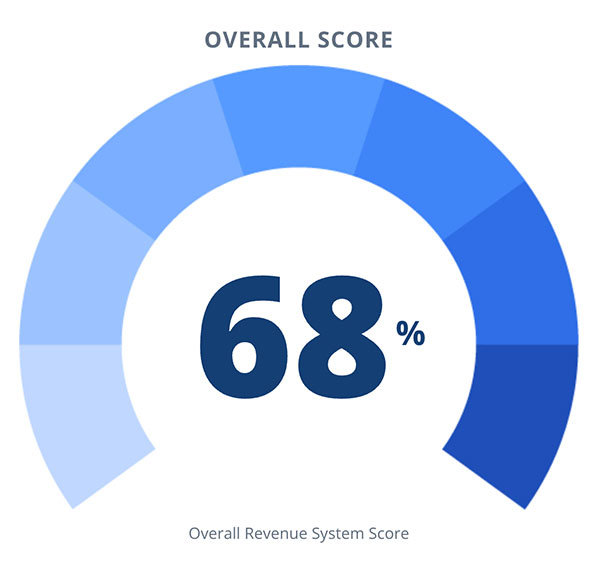
The Revenue System Self-Assessment™ scores each stage 1-10. The lower the score, the bigger the likely leak. Use the score to prioritize where to measure first.
What to Do After You Have an Estimate
Don’t just sit with the number. Use it to prioritize.
- If the biggest leak is Speed-to-Lead, fix routing and alerts.
- If it’s Sales Conversion, audit your discovery and proposal process.
- If it’s Retention, improve onboarding and referral asks.
If the total opportunity is large (e.g., >15% of revenue), book a Revenue Pipeline Diagnostic™ to get a root-cause roadmap.
You don’t have a “lead problem.” You have a leakage problem – and it’s likely 2-3x bigger than you think.
Measure it. Don’t guess. Use the Estimator, then the Self-Assessment, then the Diagnostic.
Stop leaving money on the table.