
When pipeline movement slows, most leaders blame sales.
- “Reps aren’t following up.”
- “They’re not qualifying properly.”
- “They’re letting deals go cold.”
Sometimes that’s true. But often, the problem is upstream – caused by stress elsewhere in the system.
The pipeline is a symptom. The cause is system stress.
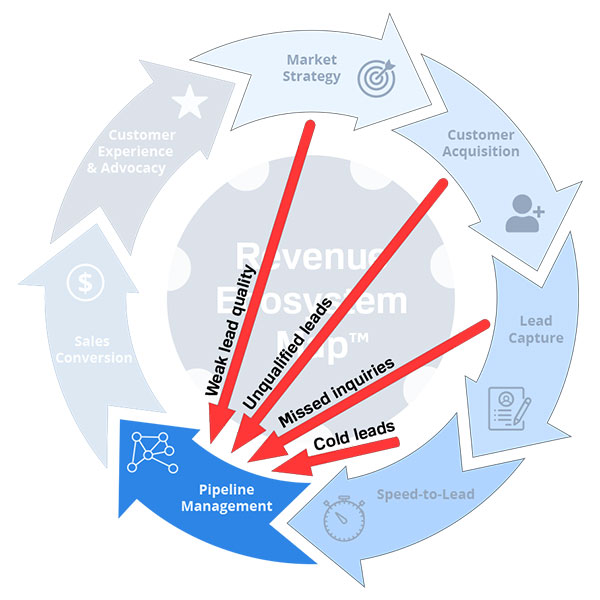
The Upstream Causes of Pipeline Problems
1. Weak lead quality (Market Strategy)
If your ICP is vague or your positioning is weak, you attract bad-fit prospects. No amount of sales skill will close a bad fit.
Indicator: High disqualification rate early in the pipeline.
2. Delayed response (Speed-to-Lead)
If response time is slow, leads have already engaged with competitors. Your reps are walking into a losing battle.
Indicator: Low contact rate; prospects seem “cold” by the time reps call.
3. No qualification before handoff (Lead Capture)
If marketing passes every lead to sales without any filtering, reps spend time on unready prospects.
Indicator: High number of leads that never move past first call.
4. Stale follow-up processes (Pipeline Management)
If there’s no automated cadence or task management, reps forget to follow up. Deals decay.
Indicator: Deals sitting in same stage for >30 days with no activity.
5. Weak sales process (Pipeline Management & Conversion)
If stage definitions are unclear, reps don’t know what “qualified” means or when to advance a deal.
Indicator: Deals jump from “new” to “closed-won” without visible stages.
Before you fire your sales team, diagnose upstream. The pipeline is a symptom, not the disease.
How to Diagnose Pipeline Stress (Systematic Checklist)
Step 1 – Map your current pipeline metrics
Metric | Healthy Range | Action if below |
% leads contacted within 5 min | >80% | Fix Speed-to-Lead |
% deals with next step scheduled | >90% | Enforce next-step rule |
Stale deals (>60 days no activity) | <10% of pipeline value | Implement aging policy |
Forecast accuracy (commit vs actual) | >80% | Review stage definitions |
Lead-to-qualified conversion rate | >50% | Fix qualification or lead quality |
Step 2 – Trace two examples
Take two deals that died recently. Trace backward: at which stage did they stall? Was it after first contact? After proposal? After demo?
Step 3 – Interview your reps (anonymously if needed)
Ask them:
- “What stops you from moving deals forward?”
- “What information do you wish you had earlier?”
- “Where do leads get stuck?”
Step 4 – Review your CRM stage definitions
Are they clear? Do reps use them consistently? If not, redefine.
Step 5 – Check your lead sources
Compare pipeline conversion by source. A source with high lead volume but low pipeline progression may be delivering low-fit leads.
Real Client Example: The “Lazy Reps” That Weren’t Lazy
Client: B2B software company, $12M revenue.
Symptom: Pipeline stalled. Reps claimed they were following up, but deals weren’t moving.
Initial thought: “Reps are lazy.”
Diagnosis: We interviewed reps and reviewed CRM logs.
Findings:
- Leads were routed manually (took 2-4 hours).
- No automated follow-up tasks.
- CRM stage definitions were vague (no exit criteria).
Result: Reps were not lazy. They were working in a broken system.
Fixes:
- Automated lead routing (instant).
- Created stage exit criteria (e.g., “Qualified” requires BANT).
- Installed automated follow-up tasks for every deal.
Outcome: Pipeline velocity increased 40% in 60 days. Same reps. No new hires.
Your team is likely not the problem. Your process is.
How the Self-Assessment Helps
The Revenue System Self-Assessment™ asks specific questions about:
- Pipeline stage clarity
- Next-step discipline
- Manager inspection cadence
- Stale deal management
If you score low in Pipeline Management, the assessment will flag it as a priority.
The Estimator Connection
The Revenue Leakage Estimator™ doesn’t directly measure pipeline health, but it can estimate the financial impact of stale deals.
Example: If 15% of your pipeline is stale, and your close rate on active deals is 20%, that stale value may be overstating your forecast. Use the Estimator to quantify the potential opportunity of cleaning the pipeline.
When to Book a Diagnostic
If you’ve tried to fix pipeline problems and nothing works – or if you don’t know which upstream stage is causing the stress – book a Revenue Pipeline Diagnostic™.
We’ll review your CRM data, interview your team, and deliver a roadmap that addresses the root cause, not just the symptom.
Stalled pipelines are rarely about “lazy reps.” They are about system stress upstream.
Before you blame sales, diagnose:
- Lead quality
- Response time
- Qualification process
- Stage definitions
- Follow-up cadence
Fix the system, and the pipeline will move.