
Most companies treat retention as a back-office issue. Customer service handles it. Onboarding is an afterthought. Churn is accepted as “normal.”
This is a dangerous mistake.
Churn does not exist in isolation. It directly increases your Customer Acquisition Cost (CAC), reduces referrals, damages your reputation, and forces you to spend more just to stay flat.
It’s a loop – and when the loop is broken, growth becomes unnecessarily expensive.
The Hidden Math of Churn (Why It’s a Growth Killer)
Basic example:
- 500 active customers
- Average monthly revenue per customer: $1,000
- Monthly churn rate: 5%
- CAC: $2,000
Each month, you lose: 500 × 5% = 25 customers
Lost monthly revenue: 25 × 1,000=1,000=25,000
Replacement cost: 25 × 2,000=2,000=50,000 in acquisition spend just to stand still
Now reduce churn to 3%:
- Lost customers: 15 (instead of 25)
- Lost revenue: 15,000(saved15,000(saved10,000/month)
- Replacement CAC savings: $20,000/month
Total monthly gain from 2% churn reduction: $30,000
That’s $360,000 per year – without adding a single new customer.
Reducing churn by 2% can be worth more than increasing lead volume by 20% – because you keep what you already have.”
The Loops (How Retention Feeds Acquisition)
Loop 1: Referrals
A happy customer refers a colleague. That referral becomes a new lead with higher trust, lower cost to acquire, higher close rate, and longer lifetime value.
If you don’t ask for referrals, this loop is broken.
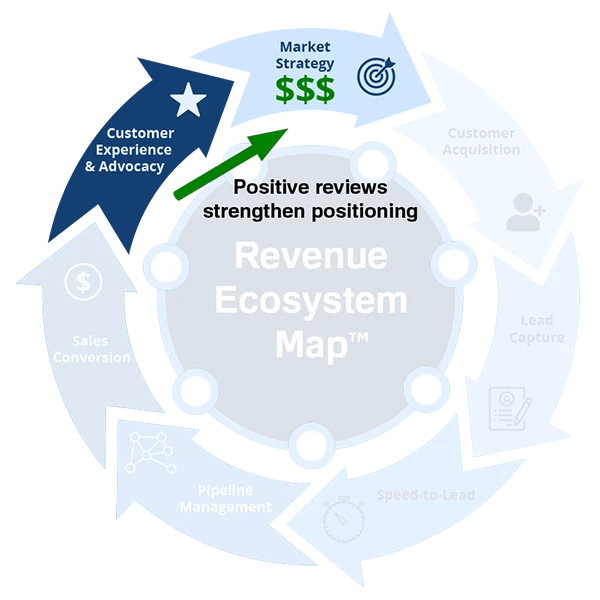
Loop 2: Reviews & Reputation
A retained customer leaves a 5-star review. That review influences dozens of future prospects. It strengthens your brand and improves conversion on your website.
If you don’t ask for reviews, this loop is broken.
Loop 3: Lower CAC
Every customer who stays reduces the number of new customers you need to replace them. You can spend less on ads for the same growth.
If churn is high, you’re forced to spend more on acquisition – a hidden tax.
Loop 4: Upsells & Expansion
A retained customer buys additional services. That revenue has zero acquisition cost and high margin.
If you don’t have an upsell process, you’re leaving growth on the table.
Why Most Retention Systems Fail
- Onboarding is weak – Customers don’t see value early. They churn before their first renewal. Signs: High churn in first 30-90 days. Low NPS after onboarding.
- No proactive communication – Silence equals indifference. Customers who don’t hear from you assume you don’t care. Signs: No regular check-ins, no milestone emails, no usage tracking.
- No churn warning system – You don’t know who is at risk until they leave. Signs: You’re surprised when customers leave.
- No referral ask – Happy customers are never asked to refer. Signs: Low referral volume despite high satisfaction.
- No offboarding process – When customers leave, you don’t ask why. Signs: Churn reasons are not tracked or analyzed.
How to Build a Retention Engine (Practical Steps)
Step 1 – Fix onboarding
The first 30 days predict long-term retention.
- Welcome email or call within 24 hours.
- Clear timeline of what happens when.
- Quick win delivered within first week.
- Identify a customer success owner.
Step 2 – Measure retention metrics
- Monthly churn rate (by cohort)
- Net Revenue Retention (NRR)
- Customer satisfaction (NPS or survey)
- Usage frequency
If you can’t measure it, you can’t improve it.
Step 3 – Proactive communication
- Monthly check-in emails or calls.
- Quarterly business reviews for high-value accounts.
- Milestone celebrations (anniversary, usage milestone).
Step 4 – Ask for referrals and reviews
At the moment of highest satisfaction (e.g., after a big win, at renewal), ask:
- “Would you be willing to refer us to a colleague?”
- “Could you leave a review on Google?”
Make it easy: provide a template or a link.
Step 5 – Monitor churn risk
- Track login frequency, support ticket volume, payment delays.
- Flag accounts with decreasing usage.
- Assign a retention agent to reach out before they churn.
Step 6 – Learn from lost customers
When a customer leaves, ask:
- Why did you decide to leave?
- What could we have done differently?
- Would you consider returning if we fixed X?
Use the answers to improve.
The most profitable customer is the one you already have. Retention is not a cost center – it’s a growth multiplier.
Real Client Example: The Retention Loop Turnaround
Client: SaaS subscription business, $5M ARR.
Problem: Monthly churn was 8% – well above industry average. CAC was rising because they needed to replace lost customers constantly.
What they did:
- Added a 30-day onboarding call for every new customer.
- Implemented monthly NPS surveys and flagged detractors.
- Created a customer success role to handle at-risk accounts.
- Started asking for reviews at the 90-day mark.
Results (6 months):
- Churn dropped from 8% to 4.5%
- NPS increased from 35 to 62
- Referral volume tripled
- CAC decreased 15% (because fewer replacements needed)
- Revenue increased 22% without adding new acquisition spend
Investment: One customer success hire (70k/year)andautomationtools.∗∗Return:∗∗Over70k/year)andautomationtools.∗∗Return:∗∗Over1M annual.
How the Self-Assessment Helps
The Revenue System Self-Assessment™ includes questions about onboarding process, churn tracking, referral and review systems, and customer communication cadence.
If you score low in Customer Experience & Advocacy, the assessment will flag it as a priority leak.
The Estimator Connection
The Revenue Leakage Estimator™ includes a retention module. It calculates the financial impact of reducing churn.
Inputs: active customers, average monthly revenue per customer, current churn %, target churn %.
Output: monthly and annual retention opportunity.
When to Book a Diagnostic
If you’ve tried to improve retention and churn remains high – or if you don’t know why customers are leaving – book a Revenue Pipeline Diagnostic™.
We’ll analyze your churn data, interview customers, and deliver a roadmap to fix the retention loop.
Retention is not a support function. It’s a growth engine that feeds acquisition through referrals, reviews, lower CAC, and upsells.
Fix onboarding. Measure churn. Ask for referrals. Learn from lost customers.
Stop treating retention as a cost center. Start treating it as a revenue multiplier.