
You’ve seen the numbers. The Revenue Leakage Estimator™ says slow response could be costing you 200k a year .Improving close rate by 5,300k.
Now you know what improvement might be worth.
But you still don’t know why your response time is slow. Is it routing? Staffing? No SLA? After-hours coverage?
That’s the gap between estimation and diagnosis.
Estimation shows direction. Diagnosis shows cause. You need both.
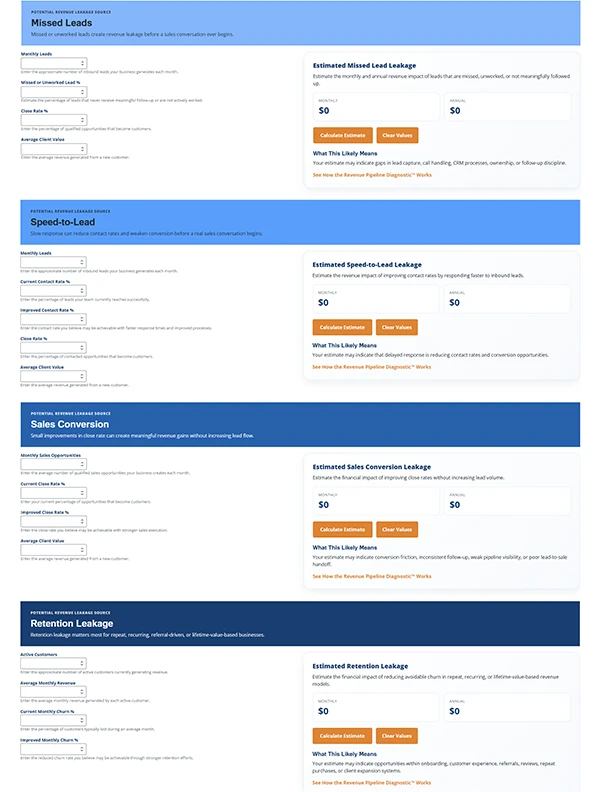
Revenue Leakage Estimator™
What Estimation Does Well
The Estimator answers one important question: “What could improvement be worth?”
It takes your inputs – lead volume, response time, close rate, churn – and calculates directional estimates.
It helps you see which variables have the biggest potential impact, compare opportunities across stages, and justify investment in diagnosis or remediation.
Example: Estimator shows Speed-to-Lead opportunity = 200k/year. Sales Conversion opportunity = 100k/year. You now know to prioritize Speed-to-Lead – but not why it’s leaking.
The Estimator tells you there’s smoke. The Diagnostic tells you where the fire is.
What Estimation Does Not Do
- It does not diagnose root causes. Why are leads missed? Routing failure? No alerts? Staffing?
- It does not map your specific system architecture. How do leads actually flow from form to rep?
- It does not reveal interactions between stages. Does fixing response time also improve close rate? Maybe, but the Estimator doesn’t model that.
- It does not provide a prioritized roadmap. What to fix first, second, third? That requires understanding dependencies.
Estimation is a compass. Not a map.
What Diagnosis Provides
A proper Revenue Pipeline Diagnostic™ goes beyond estimation.
It answers:
- Why is response time slow? (Manual routing? No alerts? After-hours gap?)
- Where are leads lost? (Which stage has the highest dropoff?)
- What are the dependencies? (If we fix response, will pipeline handle the volume?)
- What should we fix first, second, third?
Example output from a real Diagnostic:
- Root cause of slow response: manual lead routing (24 hour delay).
- Root cause of low close rate: no proposal follow-up cadence.
- Dependency: fixing response first will increase lead volume, which requires pipeline inspection to handle.
- Roadmap: Week 1 – automate routing and alerts. Week 2 – implement proposal follow-up. Week 3 – train managers on pipeline inspection.
That’s actionable. That’s a plan.
Real Example: Estimation Alone Would Have Missed This
Company: $8M home services firm.
Estimator results: Speed-to-Lead opportunity: 400k/year. Sales Conversion opportunity: 250k/year.
Action based on estimation alone: They focused on Speed-to-Lead.
Diagnostic (after estimation): We found that the real root cause of slow response was not just routing – it was that after-hours calls (40% of volume) went to voicemail with no callback system. Leads called at 8pm, left a message, and never heard back until 9am – by which time they had called competitors.
Fix: Missed-call text-back automation for after-hours. Cost: $2k.
Result: Response time at night dropped from 13 hours to 2 minutes. Contact rate from after-hours leads increased 3x.
Without diagnosis, they might have spent $50k on a new phone system or hired more staff – fixing the wrong cause.
The Estimator pointed to Speed-to-Lead. The Diagnosis found the specific after-hours leak. Fixing that cost 2k and returned 200k annual. That’s the power of diagnosis.
How to Use Both (Practical Workflow)
Step 1 – Run the Estimator – Get directional estimates for each stage.
Step 2 – Identify high-opportunity stages – Pick the 12 stages with the largest estimated impact.
Step 3 – Decide: DIY diagnosis or full Diagnostic? – If the root cause seems obvious, fix it yourself. If unclear or you’ve tried and failed, book a Diagnostic.
Step 4 – Diagnose – Get specific root causes, dependencies, and a roadmap.
Step 5 – Remediate – Fix in priority order.
How the Self-Assessment Fits
The Revenue System Self-Assessment™ gives you stage scores. Low scores point to potential leaks. The Estimator quantifies them. The Diagnostic finds root causes.
Sequence: Self-Assessment (where) → Estimator (how much) → Diagnostic (why) → Remediation (fix)
When to Skip the Diagnostic (And When Not To)
Skip the Diagnostic if: the leak is obvious and easy to fix, the estimated opportunity is small (<$50k), or you have internal expertise to diagnose and fix.
Book a Diagnostic if: you’ve tried to fix a leak and nothing worked, the estimated opportunity is large (>$100k) and you don’t know the root cause, you have multiple potential leaks and don’t know where to start, or you want a neutral, external perspective.
Estimation shows direction. Diagnosis shows cause.
Use the Estimator to prioritize. Use a Diagnostic to understand why.
Then fix with confidence – not guesswork.