
Every day, you see the same dashboards, the same reports, the same frustrations. Over time, you normalize what’s broken.
A slow response time becomes “just how we operate.” A messy pipeline becomes “typical for our industry.” Weak follow-up becomes “they’ll call if they’re interested.”
This is the danger of internal familiarity.
Internal teams have blind spots. They see symptoms every day and stop noticing them. That’s why misdiagnosis is so common – and why an external, structured diagnostic is often the only way to see reality.
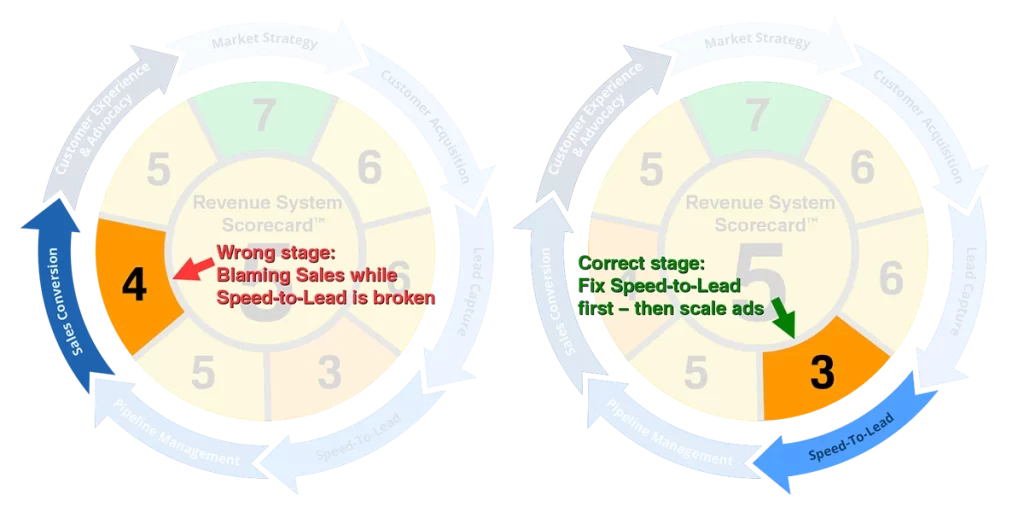
Mistake – Optimizing the wrong constraint. Correct – Fixing the real bottleneck.
The Most Common Misdiagnoses
Symptom | Common Internal Misdiagnosis | Actual Root Cause (from Diagnostics) |
Low conversion | “Bad leads” | Slow response (leads go cold) |
Stalled pipeline | “Lazy reps” | No stage definitions or nextstep discipline |
High churn | “Product issues” | Weak onboarding or no proactive communication |
Rising ad costs | “Channel saturation” | Poor lead capture or followup (wasting spend) |
Low referral volume | “Customers aren’t happy” | No referral process (you never asked) |
Forecast misses | “Reps are optimistic” | Unclear stage exit criteria, stale deals |
What looks like a people problem is often a process problem. What looks like a lead problem is often a response problem. Don’t guess – diagnose.
Why Internal Teams Can’t See Their Own Leaks
- Normalization – You’ve been seeing the same issue for months or years. It becomes “normal.” You stop feeling the urgency.
- Confirmation bias – You look for evidence that supports your hypothesis. If you think sales is the problem, you’ll notice every missed follow-up. You won’t notice that leads are coming in after hours with no response.
- Lack of external benchmark – You don’t know that a 4-hour response time is 10x slower than the industry leader. You think you’re “average.”
- Political pressure – “Marketing is failing” is an easier conversation than “Our lead routing and follow-up are broken.”
- No structured framework – You don’t have a way to analyze the system stage by stage. You react to symptoms, not causes.
Real Example: The “Lazy Reps” That Weren’t Lazy
Client: B2B services, $10M revenue.
Symptom: Pipeline stalled. Reps claimed they were following up, but deals weren’t moving.
Internal misdiagnosis: “Reps are lazy. Need new sales manager.”
Actual root cause (from Diagnostic): Leads were routed manually (24 hour delay). No follow-up tasks in CRM. Stage definitions were vague (no exit criteria).
Fix: Automated routing, SLA, task automation, redefined stages.
Result: Pipeline velocity increased 40% in 60 days. Same reps. No new manager.
Cost of misdiagnosis: Would have been 150k in hiring, severance, training. Actual fix cost: 8k.
How to Overcome Misdiagnosis
Step 1 – Accept that you have blind spots – No matter how smart your team is, internal familiarity hides reality. Seek external perspective.
Step 2 – Use a structured framework – Don’t rely on intuition. Use the Revenue Ecosystem Map™ to look at all 7 stages.
Step 3 – Get baseline measurements – Take the Revenue System Self-Assessment™. Low scores point you to where to look deeper.
Step 4 – Quantify the opportunity – Use the Revenue Leakage Estimator™ to see what fixing each stage could be worth.
Step 5 – Get an external diagnostic – If the stakes are high (>$100k opportunity), book a Revenue Pipeline Diagnostic™.
The Cost of Misdiagnosis (Real Numbers)
- Example 1: Misdiagnosed as “bad leads” → spent 50k on new ad channels. Actual problem: slow response. Fix cost: 15k. Wasted $35k.
- Example 2: Misdiagnosed as “sales need training” → spent 30k on trainer. Actual problem: undefined pipeline stages. Fix cost: 5k. Wasted $25k.
- Example 3: Misdiagnosed as “product is weak” → spent 100k on product changes. Actual problem: poor onboarding. Fix cost: 10k. Wasted $90k.
Misdiagnosis is expensive. The diagnostic fee is rarely the expensive part – wrong moves are.
How the Diagnostic Finds What You Missed
A structured diagnostic follows a consistent process: data collection, interviews, process mapping, staged analysis, root cause identification, and a prioritized roadmap.
This process finds leaks that internal teams have stopped seeing.
You can’t fix what you can’t see. And internal teams normalize dysfunction.
Stop guessing. Use the Self-Assessment to identify weak stages. Use the Estimator to quantify impact. Then get a Diagnostic to find the real root causes.
Misdiagnosis is expensive. Clarity is cheap.