
When revenue growth stalls, the instinct is to do something. Anything. Add headcount. Increase ad spend. Launch new campaigns. Hire consultants or trainers.
But if the real constraint is internal – slow response, messy pipeline, weak follow-up – those moves just amplify waste. You’re pouring fuel on a fire that’s already burning in the wrong place.
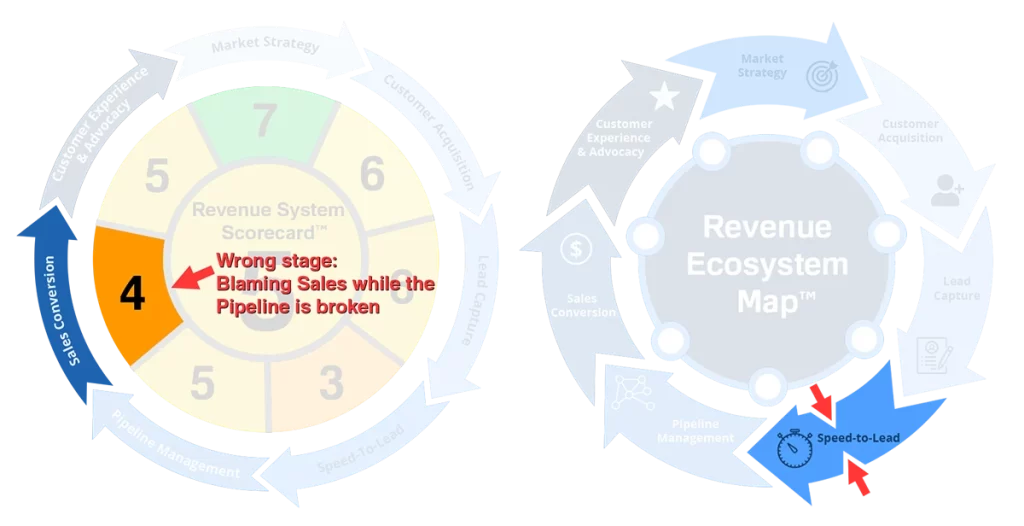
Revenue Ecosystem Map™ Speed-to-Lead bottleneck
The Patterns of Wasted Effort
What You Scale | The Real Constraint | Why It’s Wasted |
More leads | Slow response | Leads go unanswered, waste increases |
More salespeople | No qualification process | Reps spend time on unready prospects |
Ad spend | Weak lead capture | Traffic comes, leads don’t |
Sales training | Undefined pipeline stages | Skills without process = confusion |
New CRM | No sales process | Software digitizes chaos |
Customer success hires | No retention process | Hiring doesn’t fix missing workflows |
Scaling effort on the wrong stage doesn’t fix the problem – it makes the waste bigger.
Real Example: Scaling Chaos
Client: Home services company, $5M revenue.
Symptom: Inconsistent revenue. Some months good, some bad.
Their solution: Hired two additional sales reps (+40% headcount). Also increased ad spend by 30%.
Result: Revenue didn’t move. Reps were frustrated. Ad costs went up, but leads didn’t convert.
Our diagnostic: The real constraint was Speed-to-Lead – response time averaged 3 hours. New reps were calling cold leads. More ads meant more leads sitting unanswered.
Fix: Automated routing, lead alerts, SLA. Cost $5k.
Result: Response time dropped to 5 minutes. Contact rate tripled. Revenue up 35% in 90 days – with the original rep count.
Wasted investment before diagnosis: $80k (extra reps + ad spend). Cost of right fix: $5k. Return: Over $1M annual.
Why Companies Keep Scaling the Wrong Stage
- Pressure to act – When revenue stalls, waiting feels dangerous. So you act – even if you’re acting blindly.
- Visibility bias – You can see ad spend and headcount. You can’t see a slow response system without measuring it.
- “More is better” fallacy – If some leads are good, more leads must be better. Not if you can’t respond to the ones you have.
- No diagnosis before scaling – You wouldn’t build a factory without knowing the bottleneck. But you’ll add salespeople without checking the pipeline.
How to Scale Intelligently
The sequence is simple: Measure → Diagnose → Prioritize → Scale
Step 1 – Measure – Take the Revenue System Self-Assessment™. Score all 7 stages.
Step 2 – Diagnose – Find the root cause of your lowest-scoring, highest-impact stage. Use the Estimator to quantify.
Step 3 – Prioritize – Fix the bottleneck first. Don’t spread effort.
Step 4 – Scale – Now, and only now, add resources. More leads, more reps, more ads – but only after the system can handle them.
The 5 Questions to Ask Before Scaling
Before you add headcount or budget, ask:
- Have we measured the current capacity of the stage we’re scaling? (If not, pause.)
- Is this stage the true bottleneck? (Use the Estimator to compare.)
- What will break if we scale this stage without improving the next one? (e.g., more leads without better response.)
- What is the cost of scaling the wrong stage? (Estimate wasted spend.)
- What would we gain by fixing the real bottleneck first? (Often 5-10x higher ROI.)
How the Self-Assessment and Estimator Prevent Waste
- Self-Assessment identifies weak stages. Low scores are warnings.
- Estimator quantifies the opportunity cost of not fixing the bottleneck.
When to Book a Diagnostic
If you’re about to make a significant scaling investment (e.g., hiring, ad spend, new software) and you’re not certain you’re fixing the right bottleneck, book a Revenue Pipeline Diagnostic™ first.
The diagnostic fee is a fraction of what you might waste scaling the wrong stage.
Most improvement effort is wasted on the wrong stage. Don’t scale chaos.
Measure. Diagnose. Prioritize. Then scale.
Fix the bottleneck first. Then add resources. That’s how you grow efficiently.