
Most growth efforts fail not because of poor execution, but because of the wrong sequence.
They try to fix leaks before measuring them. They implement solutions before diagnosing root causes. They scale before stabilizing.
The sequence that works is simple, repeatable, and proven.
Here it is – the five-step process that turns revenue leakage into measurable growth.
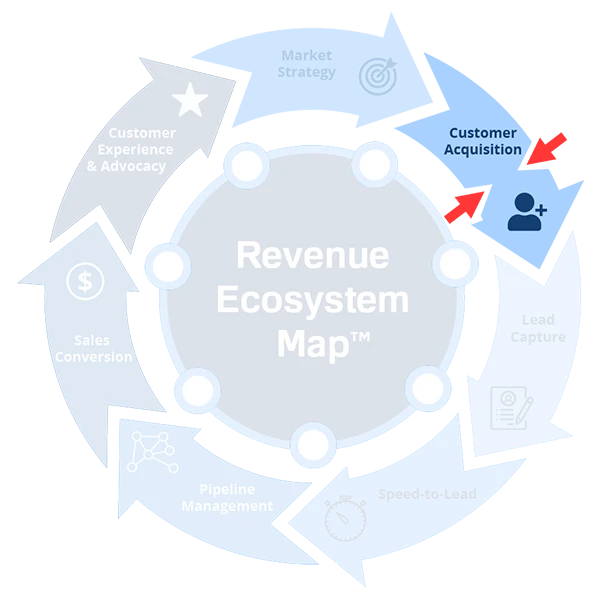
Revenue Ecosystem Map™ Customer Acquisition bottleneck
Step 1 – Self-Assessment (Free, 7 Minutes)
What it is: A 30-question diagnostic that scores your revenue system stage by stage (110).
What you get: Stage-by-stage scorecard, visual leak profile, personalized summary.
Why it’s first: You can’t fix what you don’t measure. It’s free, fast, and no email required.
Decision after this step: If scores are all > 7, you may just need optimization (skip to Step 3). If any score < 4, proceed to Step 2.
Step 2 – Estimator (Free, 2 Minutes)
What it is: A financial impact tool that calculates what improving your weak stages could be worth. Dollar estimates for missed leads, slow response, weak conversion, and churn.
Why it’s second: Knowing you have a leak isn’t enough. You need to know how much it’s costing you to prioritize.
Decision: If estimated opportunity < $50k, fix it yourself. If > $50k and you don’t know the root cause, proceed to Step 3.
Step 3 – Diagnostic (Paid, High ROI)
What it is: A structured 26 week analysis of your entire revenue system.
What you get: Stage-by-stage scorecard, Revenue Leakage Map, System Architecture Diagram, Leakage Index, and – critically – a prioritized roadmap.
Why it’s third: Estimation shows what might be worth. Diagnosis shows why it’s broken and how to fix it.
Step 4 – Remediation (Implementation)
What it is: Executing the fixes identified in the Diagnostic – system changes, automation, process redesign, training.
Why it’s fourth: You don’t implement before you diagnose. That’s how you waste money.
Step 5 – Intelligence (Ongoing Advisory)
What it is: Continuous monitoring, KPI review, monthly strategic calls, and early leak detection.
Why it’s fifth: Once your system is healthy, you need to keep it healthy. New leaks emerge. Intelligence catches them early.
Why the Sequence Works
- Step 1 tells you where you’re weak (direction).
- Step 2 tells you how much it’s costing (magnitude).
- Step 3 tells you why it’s happening (root cause).
- Step 4 fixes it (action).
- Step 5 keeps it fixed (sustainability).
You wouldn’t build a house starting with the roof. Don’t build revenue growth starting with implementation.
What Happens When You Skip Steps
- Skip Step 1 (no measurement): You guess where the leak is. Often wrong. Waste money.
- Skip Step 2 (no quantification): You fix something that doesn’t matter economically.
- Skip Step 3 (no diagnosis): You implement without knowing root cause.
- Skip Step 4 (no implementation): Insight but no action.
- Skip Step 5 (no ongoing oversight): Gains fade.
How Long Does the Sequence Take?
Step | Duration | Cost |
1 – Self-Assessment | 7 minutes | Free |
2 – Estimator | 2 minutes | Free |
3 – Diagnostic | 26 weeks | $2.5k $12k |
4 – Remediation | 212 weeks (varies) | $5k $50k |
5 – Intelligence | Ongoing | $1.5k $8k/month |
Most clients complete Steps 13 in the first month, then decide on 4 and 5.
Where Are You in the Sequence?
Take the Self-Assessment today. See your scores. Then decide the next step.
Skipping steps leads to guesswork. Following the sequence leads to clarity.
Self-Assessment → Estimator → Diagnostic → Remediation → Intelligence.
Where are you stuck? Take the first step today.