
You’ve seen them before. A thick report. Beautiful graphics. Lots of observations.
“You have a problem here. And another problem there. Also, your response time is slow.”
That’s information. It’s not a plan.
A true diagnostic doesn’t end with a report. It ends with a roadmap – a sequenced action plan that tells you exactly what to fix first, second, third, and why.
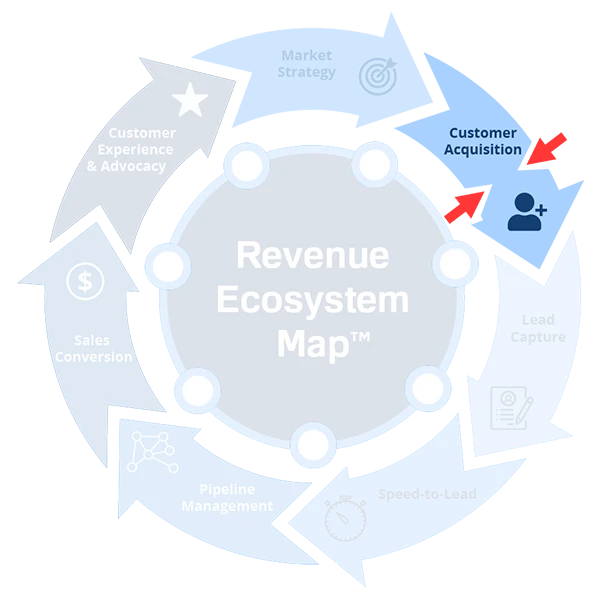
Revenue Ecosystem Map™ Customer Acquisition bottleneck
The Problem with “Reports”
Most consulting deliverables fall into one of two traps:
Trap 1 – The observation dump – “Here are 47 things wrong with your business. Good luck.” No prioritization. No sequencing. You’re left staring at a list, overwhelmed.
Trap 2 – The generic prescription – “You need to improve lead response. You should align sales and marketing. You should reduce churn.” No specifics. No root cause. No “how.”
The result: The report sits on a shelf. Nothing changes.
Information without a plan is just noise. A roadmap without information is a guess. You need both.
What a Roadmap Includes
A proper diagnostic roadmap answers five questions for each recommended action:
- What – specific fix (e.g., “implement automated lead routing”)
- Why – root cause it addresses (e.g., “currently manual routing causes 24 hour delays”)
- Impact – estimated financial gain (e.g., “$150k – $250k annually”)
- Effort – time and cost to implement (e.g., “$2k, 2 days”)
- Priority – sequence (e.g., “Week 1 – before fixing anything else”)
Example roadmap item:
- Priority 1 (Week 1) – Fix: Automate lead routing and install SMS alerts. Why: Current manual routing creates 24 hour delays. Impact: $200k/year. Effort: $2k, one day.
- Priority 2 (Week 2) – Fix: Implement proposal follow-up cadence. Why: Proposals currently sent with no follow-up. Impact: $150k/year. Effort: $1k, two days.
- Priority 3 (Month 2) – Fix: Redefine pipeline stages with exit criteria. Why: Stages are vague, causing forecast errors. Impact: $100k/year. Effort: $5k, one week.
Now you have a plan. Not a wish list.
Why Sequencing Matters
You can’t fix everything at once. And the order matters.
Example bad sequence: Fix close rate before fixing response time. Problem: Leads still aren’t being contacted.
Example good sequence: Fix response time first. Then qualification. Then close rate. Then retention. Each fix enables the next.
Real Client Example: From Report to Roadmap
Client: Home services company, $6M revenue.
What they had before: A “health check” report listing 15 problems, no priorities.
What our Diagnostic delivered (roadmap):
- Week 1: Install missed-call text-back automation (cost $1k, gain $150k).
- Week 2: Automate lead routing and alerts (cost $2k, gain $200k).
- Week 34: Redefine pipeline stages and train reps (cost $5k, gain $100k).
- Month 2: Implement proposal followup automation (cost $1k, gain $80k).
Result: Within 60 days, response time dropped from 2 hours to 5 minutes, contact rate doubled, revenue increased 35%. The roadmap gave them a clear, achievable sequence.
Without a roadmap, they would have tried to fix everything at once – and likely accomplished nothing.
How the Diagnostic Roadmap Is Built
The roadmap is based on three criteria:
- Economic impact – Which fixes produce the largest gain?
- Dependencies – Does one fix rely on another?
- Effort / speed – Quick, cheap wins go early to build momentum.
What You Can Do With the Roadmap
- Execute it yourself – use the roadmap as your project plan.
- Have us execute it – book Remediation™.
- Do a hybrid – your team handles some items; we handle others.
How the Self-Assessment and Estimator Lead to a Roadmap
- Self-Assessment identifies weak stages.
- Estimator quantifies potential gain.
- Diagnostic delivers the roadmap.
A report tells you what’s wrong. A roadmap tells you what to do about it, in what order, and why.
Don’t settle for a shelf ornament. Get a roadmap.