
No matter how smart your team is, you have blind spots.
You see the same dashboards, the same reports, the same frustrations every day. Over time, you normalize dysfunction. A four-hour response time becomes “just how we operate.” A messy pipeline becomes “typical for our industry.”
That’s why every client who completes a Revenue Pipeline Diagnostic™ discovers at least one leakage point they had never considered. Not because they aren’t intelligent – but because internal familiarity hides reality.
Here are real examples from our Diagnostics.
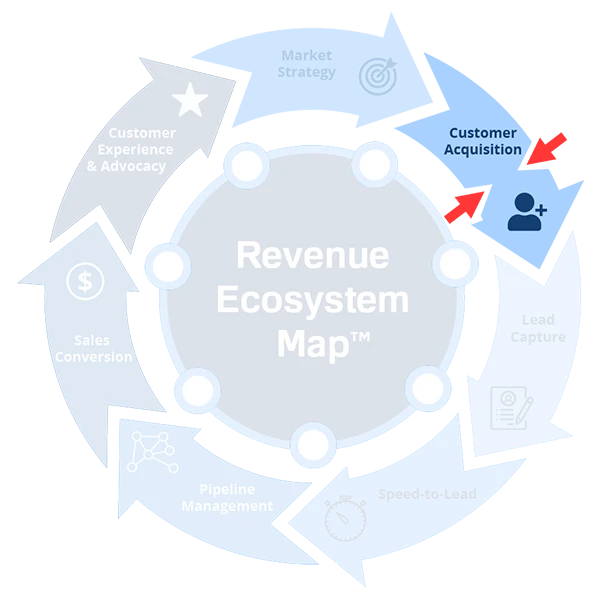
Revenue Ecosystem Map™ Customer Acquisition bottleneck
The Leak They Never Considered #1 – AfterHours Routing Failure
Client: Home services company, $5M revenue.
What they thought: “We need more leads. Marketing isn’t performing.”
What the Diagnostic found: Lead routing rules failed after 5pm. Inquiries that came in after hours sat until the next morning – by which time customers had called competitors.
Why they missed it: No one tracked after-hours lead volume. They never looked at response time by hour of day.
Fix: After-hours auto-reply text with call-back link. Cost: $1k.
Result: After-hours contact rate tripled. Yearly revenue gain: $180k.
The Leak They Never Considered #2 – Pipeline Stages That Don’t Reflect Reality
Client: B2B software company, 50 sales reps.
What they thought: “Reps aren’t following up. We need better training.”
What the Diagnostic found: Pipeline stages were vague (“qualified,” “demo,” “proposal”). Reps didn’t know what each stage meant. Deals jumped from “new” to “closed won” with no visibility. Forecasts were fiction.
Why they missed it: The CRM was configured eight years ago. No one had reviewed stage definitions since. Managers assumed the pipeline was accurate.
Fix: Redefined stages with clear exit criteria. Added required fields for stage movement. Weekly inspection.
Result: Forecast accuracy improved from 40% to 85% in 90 days. Sales cycles shortened by 20%.
The Leak They Never Considered #3 – No Automated Followup for Proposals
Client: Professional services firm, $8M revenue.
What they thought: “Prospects aren’t interested. Need better leads.”
What the Diagnostic found: Proposals were sent via email with no followup cadence. No reminders. No task creation. Deals went cold because the prospect never responded – and sales assumed lack of interest.
Why they missed it: Reps prided themselves on being “low-pressure.” They didn’t track proposal follow-up. No one monitored whether proposals were being followed up at all.
Fix: Automated proposal follow-up tasks in CRM (day 1, 3, 7, 14). Proposal templates with clear next steps.
Result: Proposaltoclose rate increased 35%. No new leads. No new reps.
The leak wasn’t the proposal – it was what happened after the proposal.
The Leak They Never Considered #4 – No AfterCall Workflow
Client: Legal in-take firm, 200 calls/day.
What they thought: “Call volume is fine. We answer most calls.”
What the Diagnostic found: 18% of calls went to voicemail. Of those, 40% were never returned. No missed-call recovery process. No follow-up task created.
Why they missed it: They only tracked answered calls. They assumed voicemails were being returned. No one audited.
Fix: Missed-call text-back automation. Voicemail to task creation in CRM.
Result: Missed calls dropped to 5%. Additional revenue: $250k/year.
Why Internal Teams Miss These Leaks
- They don’t measure what they don’t think to measure – After-hours lead volume? No one tracked it.
- They normalize dysfunction – A four-hour response time feels normal after a year. It’s not.
- They trust assumptions – “Our reps follow up on proposals.” Prove it.
- They lack an external, structured framework – You can’t see your own leaks easily.
How the Diagnostic Finds What You Missed
The diagnostic process is structured, not improvised: data collection, interviews, process mapping, stage-by-stage analysis, root cause identification, and cross-stage dependency review.
This structured approach catches what internal teams overlook.
How the Self-Assessment and Estimator Help
The Self-Assessment gives you a baseline. The Estimator quantifies the potential impact. But only a Diagnostic finds the specific, fixable root causes.
You don’t know what you don’t measure. And you normalize what you see every day.
Every client we’ve worked with discovered at least one leak they had never considered. After-hours routing. Proposal follow-up. Missed call recovery. Stage definition gaps.
A structured diagnostic finds what you’ve missed. Get one.