
Most business owners visualize revenue as a funnel.
Leads go in the top. They move through a series of stages. Customers come out the bottom. Once a customer is “won,” the journey ends.
That’s simple, intuitive – and wrong.
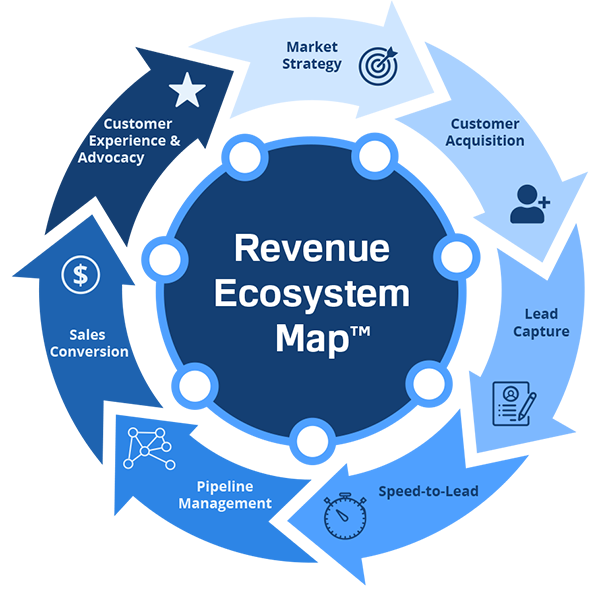
Real revenue systems are circular. After the sale, value loops back to the beginning. Customer experience feeds into market strategy. Retention lowers your cost to acquire. Conversion reliability improves your forecasting.
This is why isolated fixes almost never work. You can’t treat a circular system like a linear pipe.
The Funnel Illusion
Funnels are attractive because they reduce complexity to a single direction: movement from top to bottom.
But in reality:
- A happy customer leaves a review. That review attracts a new lead (top of funnel).
- A retained customer refers a colleague. That referral becomes a new opportunity.
- A loyal client buys an additional service. That upsell revenue looks just like a new sale.
The “bottom” of the funnel feeds the “top.”
If your mental model doesn’t account for that, you’ll make systematic errors.
A funnel ends at the sale. A circular system never ends. That’s why retention is a growth engine, not a cost center.
The Three Most Important Feedback Loops
In the Revenue Ecosystem Map™, three loops are particularly powerful.
1. Customer Experience → Market Strategy
Satisfied clients produce reviews, testimonials, and case studies. These assets strengthen your market positioning. Stronger positioning improves lead quality and conversion rates.
Example: A dental practice with 200 5-star reviews will attract more qualified leads than one with 20 reviews – even if they run the same ads.
2. Retention → Acquisition Cost (CAC)
Every customer who churns must be replaced. Churn forces you to spend more on ads, sales outreach, and marketing to maintain revenue.
Reduce churn by 5%, and you can either keep acquisition spend the same and grow faster, or reduce acquisition spend by 5% and keep the same growth rate.
3. Conversion → Pipeline Forecasting
When conversion rates are consistent, your forecast becomes reliable. Reliable forecasts improve resource allocation – you hire the right number of reps, set realistic targets, and avoid panic spending on ads.
These loops mean every stage affects every other stage. You cannot optimize one in isolation.
Why Isolated Fixes Fail
The most common mistake we see is treating one stage while ignoring the feedback it depends on or influences.
Example 1: Doubling ad spend while response time is slow
What happens? More leads hit a slow response system. Response gets even slower. Contact rates drop. Conversion falls. You waste ad budget.
Example 2: Sales training while pipeline stages are undefined
What happens? Reps learn new skills, but they still don’t know which leads are qualified. They still chase deals that will never close. Training doesn’t fix missing process.
Example 3: Improving onboarding without fixing retention metrics
What happens? Onboarding gets smoother, but if you don’t measure churn by cohort, you’ll never know if customers are leaving three months later. The leak moves downstream.
Isolated fixes don’t fix the system – they just move the bottleneck.
How to Think in Loops
To avoid these mistakes, ask yourself:
- If I improve this stage, which other stages will it affect? (And how?)
- Which feedback loops are already working in my favor? Which are broken?
- What happens when a customer leaves? Does my system capture that signal?
Example question for Speed-to-Lead improvement:
If I cut response time from 2 hours to 5 minutes, what downstream effects will I see?
- Higher contact rate → more qualified conversations → improved pipeline fill.
- Better competitive positioning → fewer lost deals to faster competitors.
- Higher customer satisfaction → potentially more referrals (if you also have a referral ask process).
That last effect is a loop. Speed-to-Lead → customer experience → referrals → acquisition. Linear thinking misses that.
How to Diagnose Your Loops
The Revenue System Self-Assessment™ doesn’t just score stages – it reveals where loops are broken.
For example, a low score in Customer Experience AND a low score in Acquisition often indicates a broken retention loop. Happy customers aren’t referring because no one asked.
The Self-Assessment gives you a baseline. A Revenue Pipeline Diagnostic™ goes deeper, mapping your specific loops and identifying which one, if fixed, would unlock the most growth.
Stop treating your revenue system like a funnel. Start seeing it as a circular ecosystem with feedback loops.
When you understand loops, you stop wasting money on isolated fixes that don’t stick. You invest in the one stage that will cascade improvement everywhere else.
Take the free Self-Assessment to see where your loops are broken.