
When revenue growth stalls, most companies look downstream.
They blame sales. They blame the pipeline. They blame lead quality. They launch new campaigns, hire more reps, and buy better software.
But often, the real problem started much earlier – in Market Strategy.
Market Strategy is everything before a lead is generated: your ideal customer profile, your positioning, your offer, your pricing, your differentiation.
If this stage is weak, every downstream activity becomes more expensive and less effective. You can’t optimize execution on top of a weak strategic foundation.
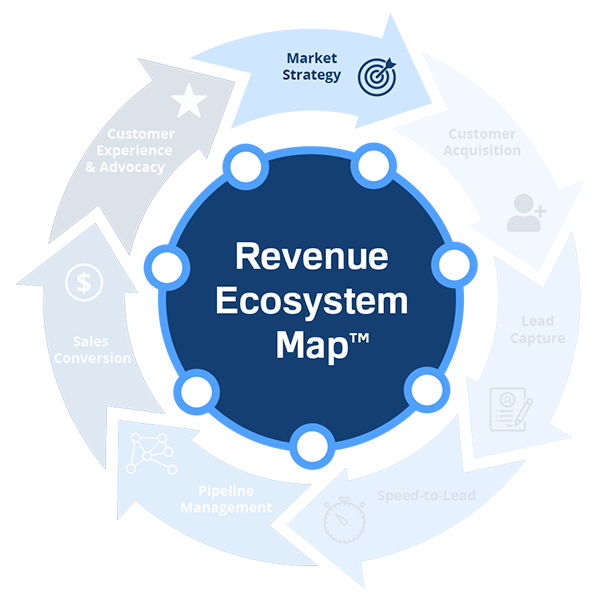
What Market Strategy Includes (And Why It Matters)
Market Strategy is not just “who we sell to.” It’s a set of interconnected decisions that determine the quality of every lead and every sale.
Component | What It Means | Why It Matters |
Ideal Customer Profile (ICP) | The specific companies, roles, and pain points you serve best | Vague ICP → wrong prospects → wasted sales time |
Positioning | How you are different from alternatives | Weak positioning → price competition |
Offer | What you sell and how you package it | Unclear offer → confused buyers → lower conversion |
Pricing | How you capture value | Wrong pricing → leaving money on the table or losing deals |
Differentiation | The unique value only you provide | No differentiation → commoditization |
A weak market strategy doesn’t just reduce conversion – it makes every lead more expensive to acquire and harder to close.
The Downstream Cost of Weak Strategy
Let’s trace how a weak Market Strategy creates problems in later stages.
Example: Vague ICP
You target “small businesses” instead of “home service companies with 10-50 employees and $2M – $5M revenue.”
Result:
- Marketing attracts unqualified leads.
- Sales spends time disqualifying bad fits.
- Close rate drops because prospects don’t match your solution.
- Revenue per customer is lower because you haven’t focused on high-value segments.
- Churn increases because you sold to the wrong buyer.
Example: Weak Differentiation
You say “we provide great service” (like everyone else).
Result:
- Prospects compare you on price.
- You discount to win deals.
- Margins shrink.
- You attract price-sensitive customers who churn faster.
Example: Unclear Offer
You have five services, but no one can explain the primary problem you solve.
Result:
- Prospects don’t call because they don’t know what you do.
- Conversion rates drop because messaging is confusing.
- Sales cycles lengthen because you have to educate before selling.
How to Diagnose Your Market Strategy
Ask yourself these questions:
- Can you describe your ideal customer in one sentence, including industry, revenue range, and primary pain point?
- Do you have a written differentiation statement that is not generic (e.g., “we care about our customers”)?
- Do your website, ads, and sales materials all use the same messaging?
- Do you know which services are most profitable, and do you focus marketing on those?
- Do your customers describe your value the same way you do?
If you answered “no” or “partially” to more than two, your Market Strategy is likely leaking.
The Role of Positioning in Growth
Strong positioning doesn’t just attract more leads – it attracts better leads.
When your ICP is clear and your differentiation is sharp:
- Advertising costs drop (higher relevance → lower CPC).
- Lead quality improves (prospects self-identify).
- Sales cycles shorten (less education, more qualification).
- Close rates increase (fit is clear).
- Retention improves (customers got what they expected).
You can’t buy better positioning with ad spend. You have to design it.
How to Fix Weak Market Strategy (First Steps)
1. Refine your ICP
Interview your best customers. Find patterns: industry, size, job title, the problem they had before buying. Then write a one-paragraph ICP. Share it with your team. Use it to filter leads.
2. Write a differentiation statement
Complete this sentence: “Our customers choose us over [competitor X or alternative] because we ____.” If you can’t finish the sentence, you don’t have differentiation.
3. Align messaging
Review your website, LinkedIn page, sales deck, and proposals. Do they all say the same thing? If not, pick one value proposition and use it everywhere for 90 days.
4. Test your offer
Ask 5 prospects: “If we changed [one thing about your offer or pricing], would that make you more likely to buy?” Use their answers to iterate.
5. Take the Self-Assessment
Our Revenue System Self-Assessment™ includes specific questions about Market Strategy. It will score your ICP clarity, differentiation strength, and offer alignment – and show you how you compare to benchmarks.
What About a Full Diagnostic?
The Self-Assessment gives you a score. A Revenue Pipeline Diagnostic™ goes deeper: it reviews your actual customer data, interviews your sales team, and delivers a prioritized roadmap for fixing Market Strategy and other stages.
But start with the free Self-Assessment. It’s fast, free, and gives you direction.
Most revenue problems don’t start with bad execution. They start with weak strategy.
Before you spend another dollar on ads or hire another salesperson, examine your Market Strategy. Define your ICP. Sharpen your differentiation. Align your messaging.
Then measure. Use the Revenue System Self-Assessment™ to score your progress.