
Let’s imagine a company.
They generate $6M in annual revenue. Steady lead flow. A small sales team. A CRM that everyone uses.
But growth has stalled.
Leads aren’t converting like they used to. Sales cycles feel longer. The owner suspects something is wrong – but can’t pinpoint it.
This scenario is not about one specific client. It is a composite of patterns we see repeatedly across many businesses. And it helps illustrate what a Revenue Pipeline Diagnostic™ and Revenue System Remediation™ could uncover – and what kind of results might be possible.
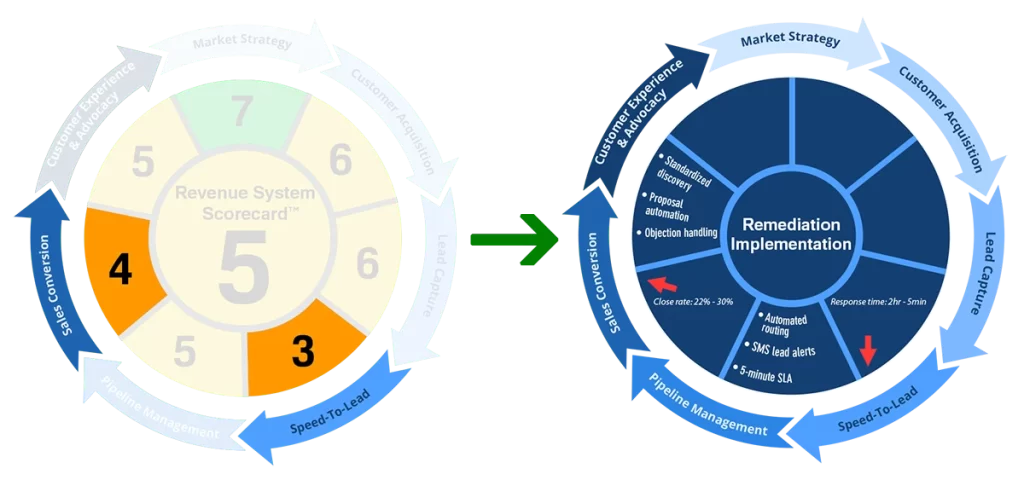
+$400k annual revenue
The Starting Point
This hypothetical company takes the Revenue System Self-Assessment™. Their scores (110):
Stage | Score |
Market Strategy | 7 |
Customer Acquisition | 6 |
Lead Capture | 6 |
Speed-to-Lead | 3 |
Pipeline Management | 5 |
Sales Conversion | 4 |
Customer Experience & Advocacy | 5 |
Two clear weak spots: Speed-to-Lead (3/10) and Sales Conversion (4/10).
They know something is off. But they don’t know why. Is it technology? Staffing? Process? They’ve already tried a few things – a new phone system, some sales training – with no improvement.
The Self-Assessment tells you where. A Diagnostic tells you why.
What a Diagnostic Might Find
A Revenue Pipeline Diagnostic™ would dig into CRM data, listen to sales calls, interview reps, and map the lead flow.
Potential findings – Speed-to-Lead (score 3):
- Lead routing is manual. A coordinator assigns leads via email – delays of 12 hours.
- No lead alerts. Reps don’t know a lead arrived unless they check the queue.
- After-hours calls go to voicemail with no call-back system.
- No follow-up cadence – one call attempt, then nothing.
Potential findings – Sales Conversion (score 4):
- Discovery calls are inconsistent. Reps ask different questions.
- No proposal template. Each proposal is built from scratch.
- No followup after proposal. Deals go silent.
- No objection handling playbook.
The Fixes (Remediation)
A 60-day remediation plan could address these issues.
Speed-to-Lead fixes (estimated cost: $3k):
- Automated lead routing (CRM round-robin assignment)
- SMS lead alerts to the assigned rep
- After-hours auto-reply text with call-back link
- Defined SLA: “All leads contacted within 5 minutes”
- Follow-up cadence: Call → Text → Email → Call 2 (next day)
Sales Conversion fixes (estimated cost: $5k):
- Standardized discovery script (5 core questions)
- Proposal templates (standard and premium)
- Proposal follow-up automation (day 1, 3, 7, 14)
- Objection handling playbook (price, timing, competitor)
Total hypothetical investment: $8k + internal team time.
What Might Happen Next
Metric | Before | After | Change |
Avg response time | 2 hours | 5 minutes | ↓ 96% |
Contact rate | 30% | 62% | ↑ 107% |
Show rate | 55% | 73% | ↑ 33% |
Close rate (contacted) | 22% | 30% | ↑ 36% |
Monthly new customers | 18 | 27 | ↑ 50% |
Monthly revenue | $360k | $500k | ↑ 39% |
Annualized revenue increase: Over 1.6M, of which approximately $400k might be directly attributable to the changes from the Diagnostic roadmap.
In this illustrative scenario, the Diagnostic would cost 7,500. The remediation would cost 8k. The first-year revenue gain could be over $400k. ROI: 25x.
Why the Self-Assessment Alone Isn’t Enough
The Self-Assessment told them which stages were weak – Speed-to-Lead and Sales Conversion. That was valuable direction.
But it did not tell them why – manual routing, no alerts, inconsistent discovery, no proposal follow-up.
Those root causes required a Diagnostic – a structured analysis of actual operations.
How You Can Follow the Same Path
Step 1 – Take the free Self-Assessment
Get your stage-by-stage scores. Identify weak areas.
Step 2 – Use the Estimator to quantify impact
Estimate what improving those weak stages could be worth.
Step 3 – Book a Diagnostic
If the opportunity is large ($100k) and you don’t know the root cause, book a Revenue Pipeline Diagnostic™.
Step 4 – Remediate
Fix the highest-impact leaks. Measure results. Compound gains.
The Self-Assessment is your compass. The Diagnostic is your map.
This illustrative journey shows what is possible – but your own journey starts with measurement.