
At any given time, one part of your revenue system limits growth more than all others.
It’s the bottleneck – the stage where improvement would unlock the most value.
That constraint could be lead quality (Market Strategy), response time (Speed‑to‑Lead), pipeline visibility (Pipeline Management), close rate (Sales Conversion), or churn (Customer Experience).
Everything else adjusts around that constraint. You can double ad spend, but if slow response is the bottleneck, you’ll just waste more money. You can train sales, but if lead quality is poor, you’re polishing a bad input.
Most companies try to improve everything at once – spreading effort, confusing the team, and slowing progress.
The efficient path is different: identify the constraint, focus on it, then move to the next.
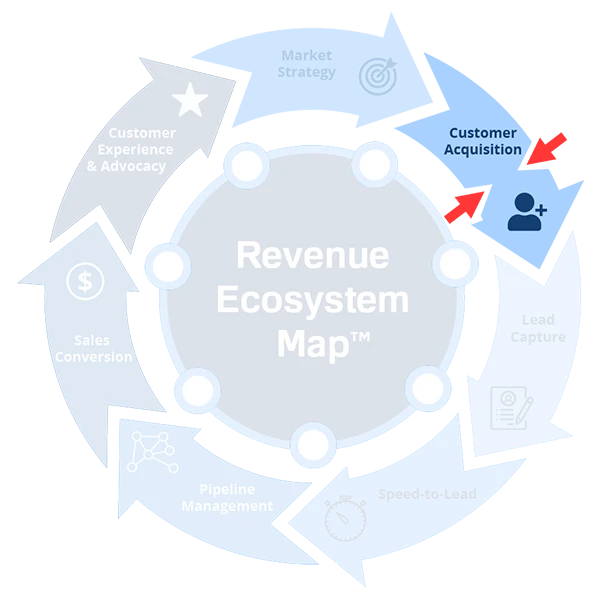
Revenue Ecosystem Map™ Customer Acquisition bottleneck
The Theory of Constraints (Applied to Revenue)
The Theory of Constraints, developed by Eliyahu Goldratt, states that every system has at least one constraint. Improving non‑constraints does not improve system throughput. Only improving the constraint does.
Example factory: If the assembly line can produce 100 units/hour but the packaging line can only handle 80, improving assembly to 120 doesn’t help – you still only ship 80. The constraint is packaging.
Example revenue system: If your response time is 4 hours, contact rate is 20%, and close rate is 20%, you close 4 customers per 100 leads. If you double leads (to 200) without fixing response, you now close 8 customers – but you spent twice as much on ads. If you fix response time (to 5 minutes, contact rate 60%), you close 12 customers – without additional ad spend.
The constraint was response time, not lead volume.
You can improve everything else, but until you break the constraint, growth is capped.
How to Identify Your Constraint
Step 1 – Score all 7 stages – Take the Revenue System Self‑Assessment™. Get a 1‑10 score for each stage.
Step 2 – Quantify impact – Use the Revenue Leakage Estimator™ to estimate the financial impact of improving each stage.
Step 3 – Look for the stage that limits everything else – Ask: If I improve this stage, does it increase overall output? Or does another stage immediately become the new bottleneck?
Step 4 – Validate with data – Don’t guess. Look at your actual metrics.
Real Client Example: The Wrong Constraint
Client: Legal intake firm, 300 leads/month.
Their assumption: Close rate was the constraint (15% vs target 25%).
What they tried: Sales training, new scripts, proposal templates. Cost: $30k.
Result: No change in close rate.
Our diagnostic: Found that response time averaged 90 minutes. Contact rate was only 35%. Of the leads never contacted, many were high‑value.
Real constraint: Speed‑to‑Lead.
Fix: Automated routing, lead alerts, SLA. Cost: $5k.
Result: Contact rate increased to 65%. Close rate on contacted leads remained 15%, but total closed customers nearly doubled.
Lesson: They were trying to improve the wrong constraint. Fixing response unlocked growth that fixing close rate never could.
The Sequence: Constraint → Focus → Improve → New Constraint
- Identify the current constraint – Use the Self‑Assessment, Estimator, and your own data.
- Focus all energy on that one stage – Don’t spread resources. Don’t try to fix everything. One thing at a time.
- Improve it – Implement the fix. Measure the result.
- Find the new constraint – After the first constraint is broken, a new one will appear. That’s normal. Repeat the process.
How the Self‑Assessment and Estimator Help
- Self‑Assessment scores each stage. The lowest score is a candidate for the constraint – but not automatically. Combine with impact.
- Estimator shows which stage, if improved, creates the largest financial return. That’s often the constraint.
When You Need a Diagnostic
If you’ve identified a candidate constraint but don’t know why it’s weak – or if you’ve tried to fix it and nothing works – book a Revenue Pipeline Diagnostic™.
We’ll analyze your system, pinpoint the true constraint, and deliver a roadmap to break it.
Growth is usually limited by one constraint. Find it. Fix it. Then move to the next.
Don’t spread effort thin. Don’t fix what isn’t limiting growth.
Focus. Improve. Repeat.